Toward the Paradigm of Expanded Science and Absolute Epistemology
For nearly a century, the scientific community has lived sealed inside a comfortable yet suffocating intellectual box. We have been taught that if a phenomenon cannot be replicated at will in a laboratory, measured with a silicon sensor, or falsified under the strict dogma of Karl Popper’s falsificationism, then it simply “does not exist” or must be discarded into the junk drawer of pseudoscience.
What immense arrogance. At its core, that is intellectual myopia: mistaking our current technological fragility — or the biological limitations of our three-dimensional existence — for the actual limits of reality itself.
Would we have dismissed Leucippus and Democritus as charlatans in ancient Greece because they lacked a particle accelerator to prove the existence of the atom? Under Popper’s rigid criterion, yes. And that is the perfect example of why the traditional method is fine for day-to-day lab work, but fails miserably at guiding the cutting edge of knowledge.
Today, from this vantage point of Scientific Ufology, we break the chains of “boxed science.” We welcome Absolute Science Epistemology: a unified paradigm capable of studying both what our eyes can see and what we are currently unable to detect due to engineering constraints or our own dimensional nature.
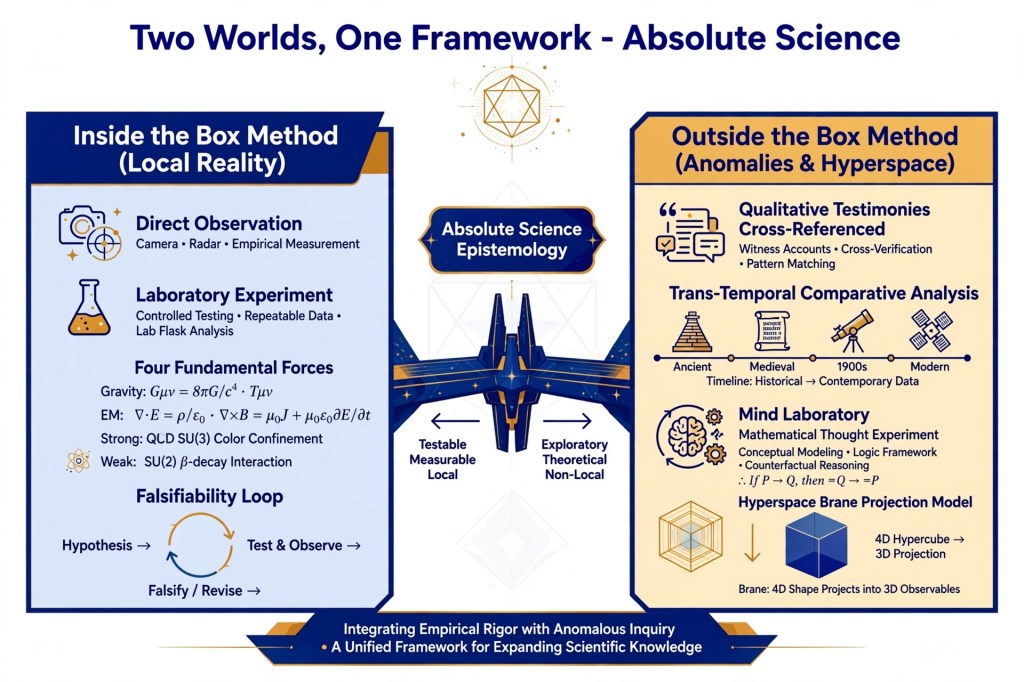
Absolute Science: Two Worlds, One Single Framework
To explore the cosmos without prejudice, we must understand that reality divides into two broad domains, each requiring its own methodological suite. We cannot judge hyperspace by the rules of a freshman chemistry experiment.
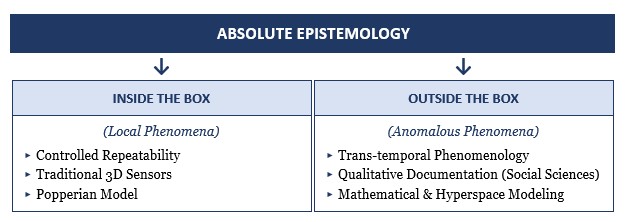
The New Unified Scientific Method
Below, we formally structure the method for operating across both frontiers of knowledge:
1. The “Inside the Box” Method (For Local Reality)
This is the traditional method. It remains useful, but only for local, stable, and controllable phenomena within our material density:
• Direct Observation: Recording the phenomenon through standard three-dimensional instrumentation (cameras, radar, optical sensors).
• Variable Isolation: Replicating the phenomenon in a controlled environment (laboratory) to rule out environmental interference.
• Quantitative Formulation: Creating equations based on the four known fundamental forces.
• Strict Falsifiability: Subjecting the hypothesis to repetitive testing to validate its consistent predictability.
2. The “Outside the Box” Method (For the Cutting Edge and Anomalies)
This is where Scientific Ufology and multidimensional physics converge. When we are faced with Unidentified Anomalous Phenomena (UAPs), consciousness interactions, or manifestations that cross over from hyperspace into our three-dimensional “brane,” the Popperian method collapses. In its place, we apply Expanded Science:
• Phase 1 — Qualitative Phenomenological Recording (The Social Method): Since we cannot control when or where a UAP will appear, we adopt the tools of the social sciences. We rigorously document the phenomenon: cross-referenced testimonies, historical records, circumstantial physical traces, and observational data.
• Phase 2 — Trans-temporal Comparative Analysis: By gathering data from similar events separated by centuries or continents, we look for patterns and constants. If the same anomalous behavior shows up in 17th-century France and on a modern military radar, statistics demonstrate the existence of the event, dismantling the “isolated hallucination” argument.
• Phase 3 — The Logical-Mathematical Thought Experiment: We replace the physical laboratory — incapable of containing the phenomenon — with the laboratory of the mind. Using pure logic and advanced mathematics, we test the internal consistency of the anomaly. If the collected data fits into a formal mathematical structure, the theory possesses intrinsic validity.
• Phase 4 — Hyperspace Hypothesis Modeling: We stop forcing the phenomenon to obey 3D laws. We formulate hypotheses assuming the event may be the projection onto our plane of a reality operating in hyperspace (as posited by String Theory). We explain anomalous behavior not as “magic,” but as higher-dimensional physics that our engineering cannot yet measure directly.
Conclusion: The End of Intellectual Veto
Absolute Science does not deny rigor; it expands it. We can no longer allow a 20th-century methodology to dictate which parts of the universe are allowed to exist and which are not. Mathematics allows us to travel where our rockets cannot reach, and logic allows us to structure what our eyes cannot see.
Ufology has ceased to be the domain of mystical speculation and has become the spearhead of a necessary and legitimate epistemological revolution. We are mapping the entire iceberg, not just the frost on its tip. Welcome to Expanded Science.
Author’s Notes
1. On the Hypocrisy in Modern Theoretical Physics and Popper’s Dogma
It is common for orthodox physicists and strict defenders of falsificationism to invoke Popper to attack higher-dimensional models (such as String Theory or our hyperspace hypotheses) under the excuse that they cannot be tested in a laboratory. Ironically, the very alternatives championed by frontier physics—such as Loop Quantum Gravity—suffer from the exact same flaw and cannot be tested with current technology either. To assume that any reality we are currently unable to measure simply “does not exist” is to repeat the same dogmatic error that validated the Four Elements theory for two thousand years, stagnating human knowledge. Extreme falsificationism confuses our temporary technological myopia with the ontological limits of the universe.
2. On the Fallibility of Testimony and the Biased Use of Psychology
Traditional skepticism often relies on psychology to dismiss Phases 1 and 2 of our method, arguing that historical testimonies are merely the product of “mass hysteria,” cultural contagion, or simple memory failures. However, statistical logic dictates that accounts from witnesses across different eras and distinct geographical locations—with zero possibility of contact between them—hold irrefutable empirical value. There can be no cultural contagion between an ancient Mesopotamian scribe, a 17th-century cleric, and a 21st-century fighter pilot who all describe the exact same anomalous physical behavior. Dismissing thousands of years of cross-temporal phenomenology based on a psychological discipline that is barely a century old—and one that has historically fractured into contradictory schools—is not scientific rigor; it is an act of academic faith.


Leave a Reply