There’s an invisible filter in modern academia. If we apply traditional Bayesian analysis to official archaeology, we notice a systemic bias: historians always set the probability of past extraterrestrial contact (paleocontact) at zero. Every anomalous object, tablet, or colossal monument must be explained, by decree, as either myth or primitive craftsmanship. This isolation rests on a presumptuous view of physics, claiming that Einstein’s proposed speed of light is an insurmountable barrier to interstellar travel.
But Einstein didn’t know everything. Today, theoretical physics already explores faster-than-light mechanisms like the Alcubierre metric or, even more speculatively, the Revoredo Mechanism, which mathematically proposes how ordinary baryonic matter could transmute into a tachyonic phase through a memory-phase tensor, enabling interstellar travel without losing original biological cohesion.
If we set aside anthropocentric bias and look at the real numbers, the visible universe contains about 1 × 10²² stars, and the invisible universe reaches orders of magnitude of 1 × 10³⁹ stars or more. Thinking we are the only intelligent life out there, or the oldest, is statistical folly (the Copernican Principle).
Our goal in this article is to develop a consistent hypothesis for the theory of paleocontact—the one flatly denied by the anthropocentric dogma of today’s scientific paradigm: falsificationism.
To that end, we will develop the hypothesis of extraterrestrial-origin life through directed panspermia. To do this, we’ll draw on philosophy, morality, religion, history, the paranormal, science, technology, and the available evidence that, for now, seems inexplicable.
We’ll start by discarding the prevailing ideas that confuse or make illogical the hypothesis we intend to develop. We’re talking about the idea that all religions, regardless of their era and origin, preserve in their records: that we were created by the Gods.
However, the truth about our creators is not in the modern myths of the Pleiades—a star cluster barely 100 million years old, far too young to harbor life, let alone intelligent life like ours. The reasons are solid and numerous.
The Pleiades (or Messier 45) are among the most beautiful and visible star clusters in the night sky, but for astrobiology, they are, literally, a barren desert.
It’s physically improbable that life developed there, let alone intelligent life. The scientific reasons are compelling and break down into three main factors: their extreme youth, the type of stars that make them up, and the violence of their environment.
1. Their Extreme Youth (No Physical Time)
Life requires billions of years to emerge and evolve. In the Pleiades, the biological clock hasn’t even started ticking.
- Age of the cluster: The Pleiades are only about 100 to 115 million years old.
- Comparison with Earth: Earth is 4.5 billion years old. Single-celled life took between 500 million and 1 billion years to appear, and intelligent life took 4.5 billion years.
- State of the planets: If planets exist around the Pleiades, they’re still molten rock, constantly bombarded by asteroids and debris from stellar formation. They haven’t had time to cool down, form oceans, or stabilize an atmosphere.
2. The Short Lifespan of Their Stars
For life to evolve, its host star must be stable for billions of years. The stars of the Pleiades are “live fast, die young” stars.
- Blue giant stars: The Pleiades are dominated by B-type spectral stars (blue giants), which are extremely massive and hot.
- Accelerated consumption: Because they’re so massive, they burn through their hydrogen fuel at a frantic pace.
- Premature death: The lifespan of these stars is only a few hundred million years (compared to our Sun’s 10 billion years). Many of the main stars in the Pleiades will explode as supernovae or become white dwarfs before a planet around them can even finish forming properly. The window for life is practically zero.
3. Hostile and Lethal Environmental Conditions
The environment inside the cluster is a hellscape of radiation and unstable gravity.
- Extreme ultraviolet (UV) radiation: Blue giants emit monstrous amounts of UV radiation and X-rays. This radiation would instantly sterilize any organic molecule or DNA strand trying to form. On top of that, their stellar winds are so violent they’d strip away the atmospheres of any nearby rocky planet.
- Gravitational instability: The Pleiades are an open cluster where hundreds of stars are densely packed (within a radius of just a few light-years). The gravitational forces of neighboring stars constantly tug at each other. This would destabilize planetary orbits, causing planets to be ejected into interstellar space or crash into their own suns.
- The reflection nebula: The cluster is currently passing through a dense cloud of gas and cosmic dust. This material blocks light irregularly and causes extreme temperature swings that would make a stable climate impossible on any world.
In short, the Pleiades are adolescent, massive, and violent stars. Scientifically, looking for life there is like looking for a mature forest in the middle of a volcanic eruption that just started a few minutes ago.
We mention the Pleiades because they’ve been the muse of several science fiction writers who claim to have been “contacted” by inhabitants of those places (and also, supposedly, from other worlds like Mars, Venus, Jupiter, or even the Andromeda galaxy), who allegedly asked them to carry out some kind of messianic or prophetic outreach.
All those ideas can be dismissed through two analyses: first, by assessing whether those places have the conditions to have generated and sustained any kind of life; and second, by assessing what practical purpose they would have had for investing time and resources to create and monitor us.
For example, in the case of possible intelligent life from the Andromeda galaxy, one might ask: why would they create life on a world located in another galaxy, 2.5 million light-years away, instead of somewhere else in their own galaxy?
The reason an advanced civilization would spend time and enormous resources seeding life conditions on another world would basically be that their own world is dying—for example, because their star or nearby stellar system is fading—which would force such a super-civilization to drop from the peak of Maslow’s hierarchy down to a position of mere survival. In that case, the answer is: it wouldn’t be logical for them to travel to the Milky Way to do so; rather, they’d look for a new home within the Andromeda galaxy itself.
They would stay in Andromeda for the following reasons:
1. Distance Is an Unnecessary Obstacle
- Andromeda is gigantic: it has roughly one trillion (1,000,000,000,000) stars.
- Plenty of options: if their sun dies, they have hundreds of billions of other stars in their own galaxy to choose from as a new home.
- The intergalactic void: traveling to the Milky Way means crossing 2.5 million light-years of completely empty, cold, and dangerous space. It makes no logical sense to make that trip if there are habitable “neighbors” just a few light-years away within Andromeda. Even if there were no dangers and the trip didn’t cost nearly infinite resources, it would still make no sense to do it from that far away.
2. Law of Least Effort and Resources
- Energy cost: moving a population (or a colonization infrastructure) to another star within Andromeda would require a tiny fraction of the energy needed for an intergalactic trip.
- Travel time: an interstellar trip (within their galaxy) would take only decades or centuries at sub-light speeds. An intergalactic trip (to the Milky Way) to be feasible would also require extreme technologies that warp space-time or traverse hyperspace.
In conclusion: if only their sun were dying, the logical, efficient, and safe thing for them to do would be to move to a neighboring solar system within the Andromeda galaxy itself. Crossing space to the Milky Way would be an unnecessary drain on resources and infrastructure, since, even if they wanted to find a twin identical to their own world, Andromeda is so huge compared to the Milky Way that they’d be more likely to find it within their own galaxy than in ours.
Finally, let’s get to the source of these unfounded ideas: they all come from a group of self-proclaimed “contactees,” whose credibility is questioned by serious UFO researchers when weighed against abduction cases.
The most respected scientific ufologists in history—such as astrophysicist Dr. J. Allen Hynek and astronomer and computer scientist Jacques Vallée—drew a very clear line between “contactees” and “abductees.”
It’s not that they “believed” blindly in abductions in a mystical sense, but rather that they treated abductions as a genuine psychological and sociological phenomenon worthy of scientific study, while dismissing the contactee movement as crude fraud or messianic delusion.
The fundamental reasons for this distinction break down into four key points:
1. Psychological Profile and Attention-Seeking
- Contactees (1950s): figures like George Adamski claimed to have friendly meetings with beautiful aliens from Venus or Mars. These witnesses actively sought fame, gave paid lectures, founded religious cults, and sold books with cliché philosophical messages about world peace.
- Abductees (1960s onward): cases like Barney and Betty Hill involved ordinary people who didn’t want notoriety. In fact, they suffered deep trauma, anxiety, and severe PTSD. Many tried to hide what happened for fear of being taken for crazy, and the experience was described as a terrifying and involuntary medical violation.
2. Physical Evidence and Consistency of Trauma
- No marks on contactees: contactee stories were purely anecdotal and riddled with unsustainable scientific contradictions (like aliens living on the surface of Venus without spacesuits).
- Real trauma in abductees: Hynek and Vallée noticed that abductees showed authentic physiological reactions (sweating, rapid heartbeat) when recalling events under hypnosis. They also often had inexplicable physical marks on their bodies, scars, or “missing time” corroborated by clocks or witnesses, suggesting that something real had caused a psychological breakdown.
3. Jacques Vallée’s “Control System” Theory
Jacques Vallée studied abductions in depth and concluded that they weren’t literal extraterrestrial visits from other planets, but encounters with an interdimensional intelligence.
- In his book, Vallée argued that modern abduction accounts are nearly identical to abductions carried out by fairies, elves, and demons in ancient folklore.
- For Vallée, abductees are real victims of a “control system” of the poltergeist type that alters human perception to shape our culture over the long term. He saw contactees, by contrast, simply as people manipulated by popular mythology or by human disinformation agencies.
However, it’s worth noting that at the time Vallée wrote his book (1960s–70s), the paradigm was that nothing could travel faster than light. Today, however, we have the theoretical possibility of hyperspace travel, converting baryonic matter into tachyonic matter and maintaining its balance through memory-phase tensors. This means that a truly advanced civilization could employ these transport or concealment mechanisms, and appear—without truly being—as an interdimensional intelligence.
4. J. Allen Hynek’s Scientific Method
As scientific advisor to the U.S. Air Force (Project Blue Book), Hynek developed the famous Close Encounter scale.
- Hynek included encounters with occupants within legitimate research because witnesses were often police officers, pilots, or respectable citizens who encountered the phenomenon unexpectedly.
- He completely excluded contactees from his methodology because their stories lacked the structure of an empirical event: they weren’t scientific sightings, but purely mystical or theatrical experiences that contaminated serious UFO study.
In conclusion, for serious researchers, the contactee was a myth-teller looking for followers, while the abductee was a traumatized patient from a real anomalous experience that medical science and ufology should investigate cautiously.
Having dismissed such ideas as part of our extraterrestrial directed panspermia hypothesis—that is, that they came from the Pleiades, only 440 light-years away; or from Andromeda, 2.5 million light-years away; or from Mars, Venus, or Jupiter, just a few light-minutes away, but without verifiable conditions for life; or even from Rigel, Orion, or other similar places that emerged from the imagination of the supposed “contactees”—we will propose that directed extraterrestrial panspermia came from within our own galaxy, from a region that our scientists have designated as the best zone for the development of potential intelligent life: located 13,000 light-years from the center of our galaxy, that is, from the black hole Sagittarius A*.
This region, billions of years before Earth existed, was already conducive to the development of worlds with intelligent life. However, having already passed 4.5 billion years since then, that zone is today much more exposed to cosmic rays and explosions of novae or old stars.
Here begins the hypothesis of the extraterrestrial origin of life on Earth: directed panspermia from a region located 13,000 light-years from us and from the galactic center (Sagittarius A), in the true Habitable Zone of the Milky Way. (Our solar system is located about 26,000 light-years from Sagittarius A.)
We should note that, although it may seem that Occam’s Razor suggests it’s easier to believe in the terrestrial origin of life, for that to be the simplest explanation we have to ignore the multiple lines of evidence and records of a philosophical, cultural, religious, paranormal, archaeological, and mythological nature, as well as testimony from respectable civilian and military witnesses, along with official evidence of UAP sightings that humanity has accumulated throughout its existence.
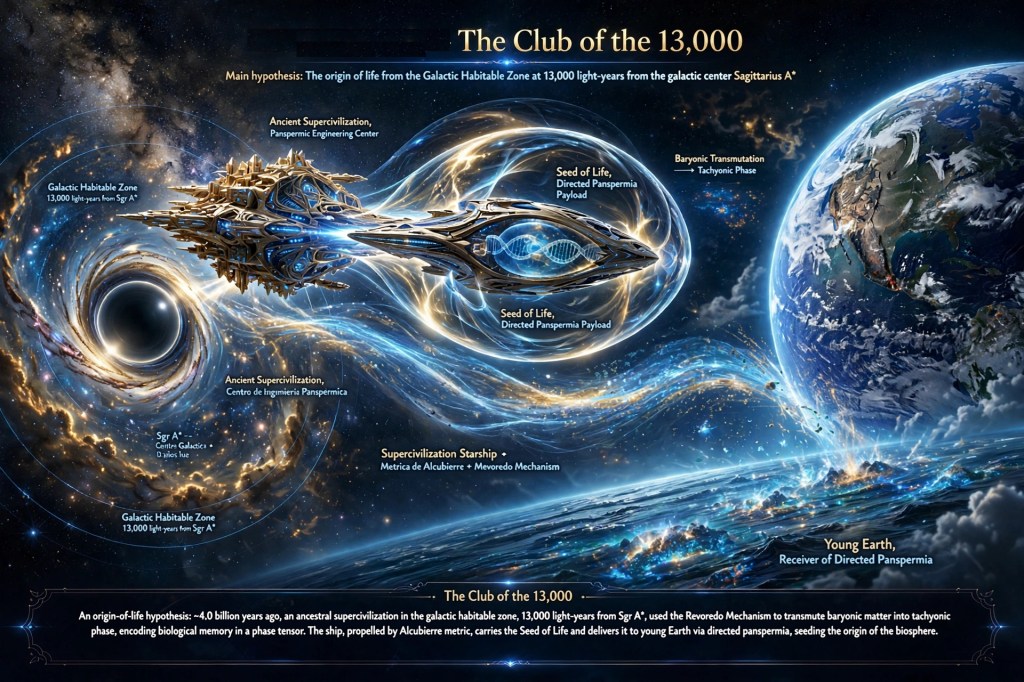
The 13,000 Club and the Origin of Man
Within this speculative framework, we propose the following scenario: billions of years ago, a coalition of advanced humanoid civilizations—whom we’ll call The 13,000 Club—would have flourished in that inner ring of the galaxy. Their worlds developed 4 billion years before ours. However, time is relentless: their stars would have aged and their systems would have begun to be exposed to cosmic radiation and nova explosions. Facing the culmination of their cosmic time, they would have looked toward the safe periphery of the galaxy: 26,000 light-years from the center, where our young Solar System was located.
Likewise, within this hypothesis, we’ll invent a name for the leading world of the 13,000 Club: we’ll arbitrarily call it Giga, and its inhabitants, Gigarians. We’ll postulate that they didn’t create us by chance, but seeded the first cell of life on Earth eons ago, through directed panspermia.
Many millions of years later, when primates evolved sharing that same basal biological signature, the Gigarians would have returned and molded the genetic code using their own DNA. They would have created us, therefore, in their own image and likeness. This would explain, within this hypothesis, why Earth science can’t isolate an “alien gene” in humans: our entire evolutionary line would be, in this framework, structurally extraterrestrial. We shouldn’t be here, but we are.
We would have been designed, according to this hypothesis, with a specific purpose: to prepare, organize, and clean up this planet to turn it into the “New World” of our creators.
This foundational event, the present hypothesis holds, would have been etched into humanity’s collective memory. That would be the reason why, when we study and unify the Sumerian, Akkadian, Babylonian, Greek, Chinese, Indian, Jewish, Christian, Yoruba, Mayan, Aztec, Guaraní, Muisca, Mapuche, Australian Aboriginal, and Maori religions, along with the Andean records of Tiahuanaco, we find that all seem to be, at bottom, the same religion. The archetype of the Instructor and Savior God repeats itself in almost identical form across all cultures: the Sumerian Enki/Ea (who defies order to save man), the Greek Prometheus (who gives us the fire of knowledge), the American Quetzalcoatl or Viracocha, and the very essence of the master Jesus, in addition to the same flood story repeating across cultures, places, and different eras. Finally, we can boil down all religious records to this: the gods came down from the skies, created us, gave us directives and guidance, and then left, promising to return at the end of times.
In fact, these extraterrestrial “deities” would have mastered biological immortality—a genetic advancement that Earth science is only beginning to glimpse in labs like David Sinclair’s at Harvard. That’s why figures like Jesus appear suddenly at age 30 to preach, with no prior records, endowed with cellular restoration capabilities, only to then “ascend to heaven in body and soul,” which textually would describe a technological extraction back to the mother ships.
The Great Betrayal: The Elite’s False Gods
Continuing with this hypothetical reconstruction, we maintain that the 13,000 Club wasn’t homogeneous. In their cosmic past, a terrible war would have broken out in the heavens between them. The leading faction of the Gigas would have prevailed and subjugated a lower class of biological servants and automaton clones, whom—for simplicity—we’ll call by the name the oldest religious records of humanity use for them: the Igigi.
The ancient Sumerians recorded in the Atrahasis Epic how the Igigi rebelled against the greater gods over their heavy workload. Physically, in this hypothesis, the Igigi would be the beings that popular ufology today recognizes as the “Grays”: slender entities, grayish skin, disproportionately large heads, and giant, dark eye sockets. And therefore, it would be no coincidence that in the Temple of the Thousand Eyes at Tell Brak (Mesopotamia), thousands of stone figurines with those same large, fixed eyes have been found. In our hypothesis, official history mistakenly calls them “votive offerings,” when in reality the ancients would have portrayed their biological supervisors.
Today, the Igigi would correspond exactly to the devils or demons of our theological scriptures. Consumed by envy toward the human being—whom they would see as the favored heir of the Gigas—and resentful of their subjugation, the Igigi would have orchestrated a master revenge plan to have Earth all to themselves and bring about the extinction of the Giga and our species.
According to this hypothesis, this faction of “traitorous Grays” would operate today in the shadows of world geopolitics, having established secret pacts with the political and military elites of Earth. They would be handing them scraps of advanced technology, reverse engineering, and sophisticated weapons blueprints under a perverse deception: making them believe they’re helping them build defenses to protect the planet from a “future alien invasion.”
But the supposed “invaders” wouldn’t be enemies: they would be, in this approach, the true owners and creators of humanity (the Gigas), on their way back to reclaim Earth. The Igigi would be using Earth’s leaders and our armies as a biological military shield, preparing humanity to fight their revenge war.
The Inevitable Outcome
It’s worth noting, within our hypothesis, that existence has always required one additional ingredient beyond space-time, matter, and energy — one that people without a sharper cast of mind tend to overlook: consciousness itself, the very thing that allows anything to become real. In our finite universe — the one we inhabit now, with space-time, matter, and energy already in place — the countless consciousnesses present across different worlds and eras act like countless small points of light illuminating a room: it’s their presence that gives existence its reality, the way light gives a room its visibility. But before the finite universe came into being, in the era of the eternal singularity, when none of those three components yet existed, the only thing that could have existed was eternal consciousness itself: a consciousness aware of itself, whose very self-awareness guarantees that nothingness cannot exist. Any sufficiently advanced being in the universe would therefore know that there is a Father God — that eternal, self-aware consciousness — who inhabits a dimension that is not our own, and that we cannot fully comprehend (the Pleroma). Therefore, this hypothesis requires validating all types of gnostic and mystical knowledge, which always were and will be part of any developed intelligence in existence. Explaining it is possible, but it would lead us too far from the central objective of the present hypothesis.
In that sense, we maintain that the scriptures of all religions, viewed in a unified way, already warn about the end of this hidden agenda. Indeed, Revelation points out precisely that, in the final times, the kings of the Earth will use their technology to “make war against the one riding the white horse and his army.” Deceived by the false gods—the extraterrestrials we call Igigi—humanity would attack, according to this hypothesis, its own Creator when the fleet of the 13,000 Club entered the atmosphere.
The end of this cosmic audit would be drastic. The victory of the Gigas, in this scenario, would be inevitable: the planet would be cleansed and, just as the different religious prophecies dictate, the “Kingdom of Heaven” would be physically established on Earth, preserving only a very small portion of humanity to accompany them: those who weren’t corrupted or deceived by the traitors’ false technology. Commercial ufology will tell you about peaceful messages from the Pleiades. Official science will tell you we’re alone. But, according to the present hypothesis, the clay tablets, the astrophysics of the galaxy, and the unified prophecies all point to a much colder reality: we would be the stage of an interstellar war of position, and the time of the harvest would already be approaching.


Leave a Reply