When you look at the enigmatic stone blocks of Puma Punku, in Bolivia, the most basic principles of engineering hit you square in the face. Perfect internal channels, precisely spaced cylindrical perforations, and the famous H-shaped blocks carved from andesite—one of the hardest rocks on the planet. Yet official archaeology’s answer to this marvel is always the same: “It was made by hitting stones with other stones and using bronze chisels.”
To uphold this narrative, academia publishes studies claiming to “debunk” the mystery, arguing that there are deviations of a few millimeters between the blocks and that therefore there is no perfection. But this argument collapses under its own weight. In modern civil construction, millimeter deviations are perfectly normal; claiming that these variations prove a crude job with bronze tools is an insult to materials science. Arsenical bronze deforms upon striking andesite. Upholding the official version requires more faith and fantasy than any other explanation.
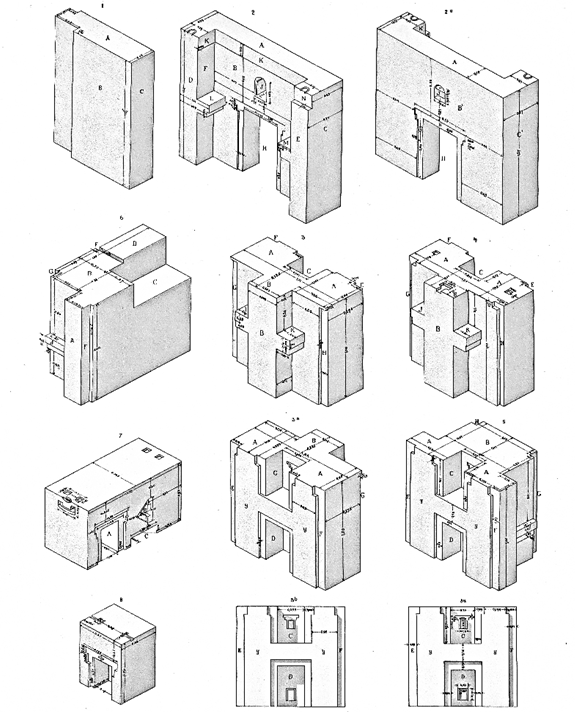
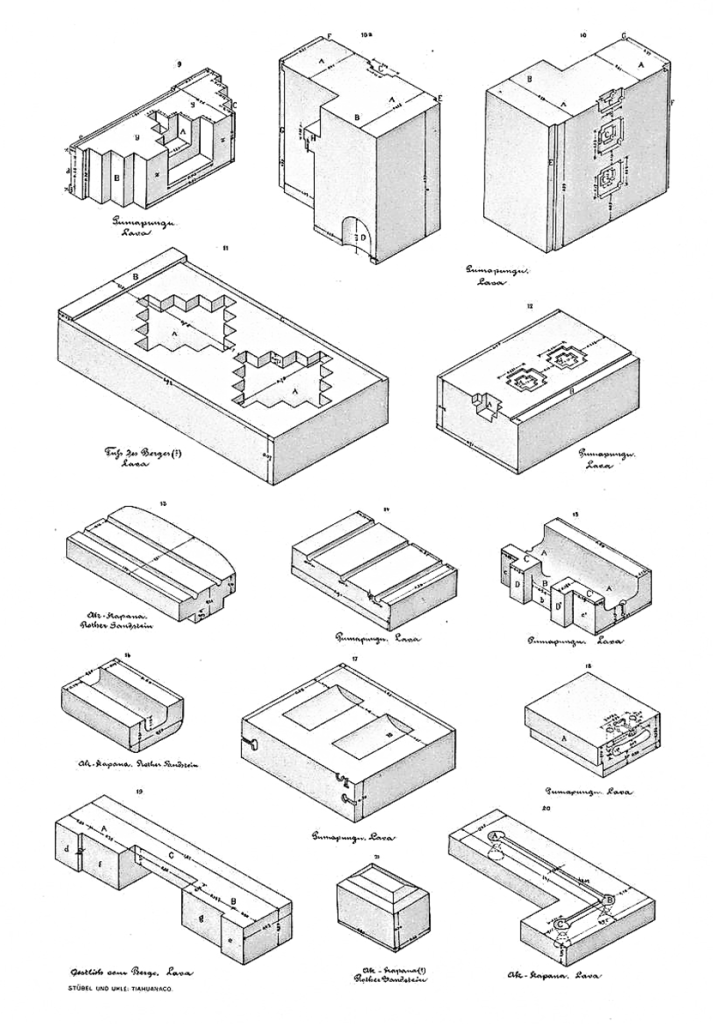
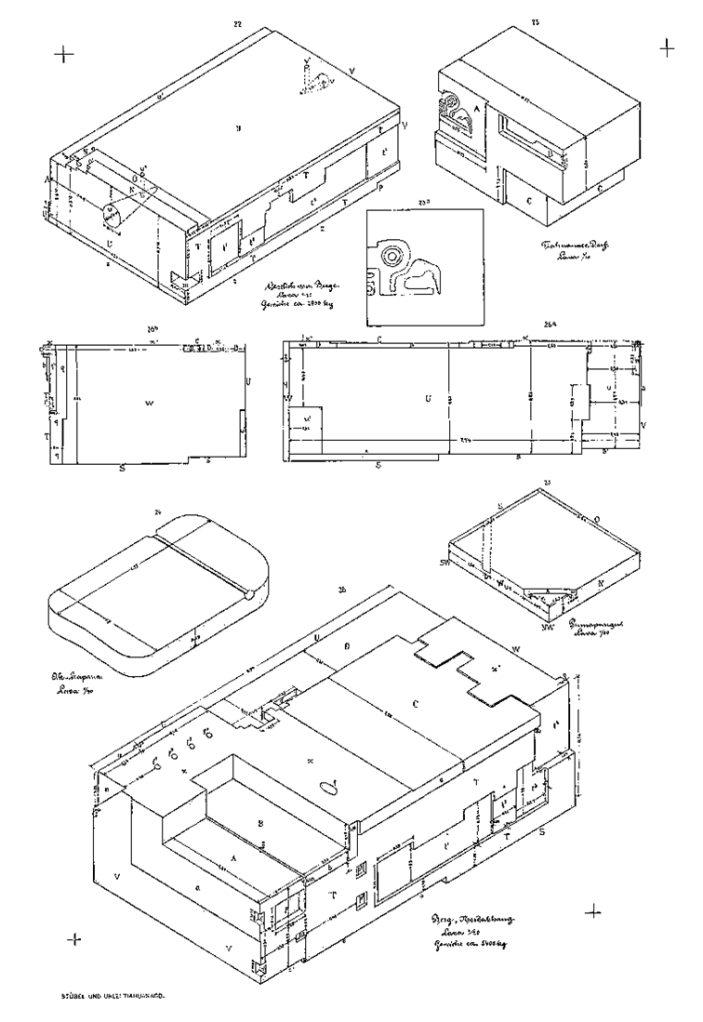
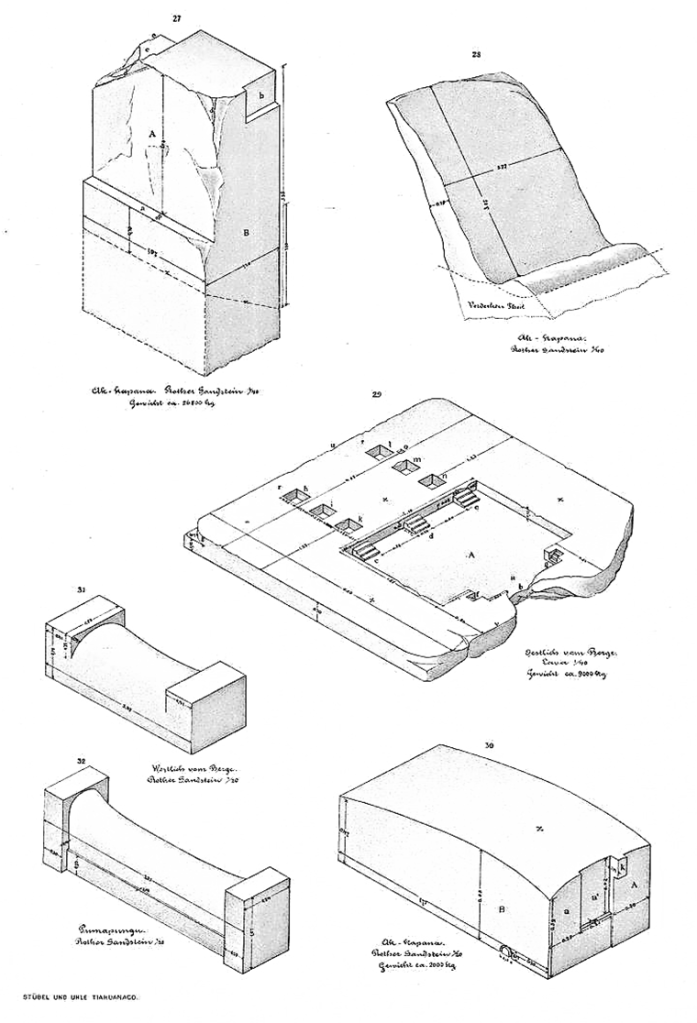
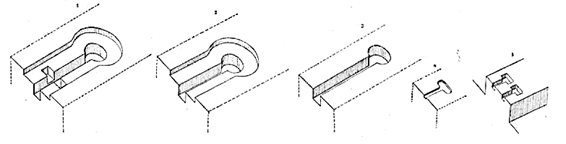
Drawings by Max Uhle and Alphons Stübel, from their 1892 publication
FRACTURE MECHANICS DOESN’T LIE
The H-blocks are not simple stone boxes. They feature longitudinal grooves with perfectly aligned internal perforations, spaced at regular millimeter intervals. That implies high-speed rotary motion and a stable drill bit with a fixed pivot point.
A bronze chisel cannot make a straight, cylindrical hole more than two inches deep in andesite without veering off course. Percussion produces conical fractures and splintering, not perfect cylinders. To achieve those equidistant perforations, you need a diamond-tipped or tungsten carbide drill, or an ultrasonic method assisted by abrasives. There is no middle ground. Saying it was done “by pounding” is like claiming you can drill a diamond with a wooden mallet. It’s not improbable—it’s mechanically incompatible with materials science.
Any mining engineer or precision machinist will confirm this: percussion produces cones, not cylinders. And Puma Punku is full of cylinders.
THE ABSURDITY OF UNNECESSARY COMPLEXITY
Modern architecture confirms that the H-blocks interlock like a three-dimensional puzzle, providing seismic stability. But attributing this anti-seismic design to a culture that left no writing, no blueprints, no prior architectural evolution, and no technological heirs is an act of faith, not science.
Throughout history, every major ancient civilization built with cubic blocks, parallelepipeds, or bricks—even when they were enormous and heavy. Why? Because that is the most efficient way to build with hand tools.
There is no practical reason for a culture with primitive tools to have made life harder for themselves by carving complex geometric shapes like the “H” blocks, unless they possessed automated cutting technology or a casting method—like geopolymers—that made such a design viable and time-efficient. Without that technology, the excess energy and time required is so absurd that no rational society would have undertaken it.
And here’s the kicker: that civilization left no trace of a learning curve. Not in pottery, not in metallurgy, not in tools. That is anti-evolutionary. Every culture leaves evidence of trial and error. Here, there is no evolution—just a finished, flawless product from day one. That, in archaeology, is a statistical anomaly that should set off alarm bells. Instead of accepting this, official archaeology prefers to force reality to fit its textbooks.
THE MATHEMATICAL TRAP: THE MISUSE OF BAYES’ THEOREM
The underlying problem isn’t a lack of evidence—it’s the recalcitrant anthropocentrism of the social sciences, a bias inherited from ancient Christian theology, which assumed that humans were the only intelligent beings in creation. Modern science swapped the religious framework for a secular one, but kept the same planetary egotism intact.
This bias manifests as a blatant methodological manipulation when Bayesian statistics are applied to evaluate hypotheses about our past:
- Bayes’ theorem tells us we must assign a prior probability to each hypothesis before testing it against physical evidence.
- When evaluating the hypothesis of local (human) origin, academia assigns it an overwhelmingly high percentage.
- When evaluating the alternative hypothesis (external or non-terrestrial intervention), archaeologists assign it, by dogmatic decree, a 0% prior probability.
Any math student knows what happens here: any amount of physical evidence, no matter how inexplicable, multiplied by zero, will always yield zero. By closing the door a priori to the non-terrestrial hypothesis, archaeology nullifies the scientific method and becomes a closed dogma.
And this is no exaggeration: intelligent life in the universe is not a hypothesis—it is a statistical certainty. With more than 10²³ stars in the observable universe, and organic chemistry being ubiquitous, the probability that we are the only ones to have emerged is less than 10⁻⁵⁰. That is not belief; that is probability theory. To deny the possibility that any of those civilizations might have visited Earth at some point is as dogmatic as denying evolution. The question is not “do they exist?” but rather “did they leave a trace?” And Puma Punku, with its cylindrical perforations that show no trace of a drill bit, is a trace that deserves to be investigated without prejudice.
OCCAM’S RAZOR USED BACKWARDS
Academia often defends itself using Occam’s Razor, the principle that “the simplest explanation is usually the correct one.” For them, the simplest thing is to imagine thousands of indigenous laborers chipping away at stone day and night for centuries.
Is that really the simplest explanation? Not at all. Properly applied, Occam’s Razor would force us to seek the hypothesis that requires the fewest absurd assumptions. The leap from “nomadic herders with bronze chisels” to “millimeter-precision anti-seismic engineering with cylindrical perforations” is a giant leap. The leap to “lost assisted technology (whether terrestrial in origin or not)” is notably smaller, because it explains all the variables at once: precision, efficiency, surface finish, symmetry, and the complete absence of trial and error.
It is far simpler and more logical to assume that an advanced technology—lost to time, whatever its origin—was used, than to believe the fantasy that bronze tools and soft stone achieved the symmetry and polish of Puma Punku without leaving a single tool mark or carving error.
THE DEFINITIVE CHALLENGE THAT ACADEMIA AVOIDS
There is a very easy way to settle this debate, but no archaeology department dares to try it. The challenge is simple:
Gather the best civil engineering and mining engineering students from your own universities and, using only the stone hammers and bronze chisels you claim were used, carve a single identical “H” block within a reasonable timeframe. And more importantly, drill one of those grooves with equidistant cylindrical perforations.
They cannot do it. No modern “experimental archaeology” project has ever replicated the internal complexity of Puma Punku with the proposed tools. This is not a rhetorical challenge; it is a falsifiable empirical test. If they can replicate it, they will have proven their hypothesis. But if official science cannot demonstrate its hypothesis in practice, then its insistence on denying alternatives is not scientific—it is fear that the timeline of human history might collapse, forcing them to rewrite their entire body of knowledge.
THE FEAR ISN’T OF EXTRATERRESTRIALS; IT’S OF LOSING THE NARRATIVE MONOPOLY
The fear isn’t of extraterrestrials. The fear is of losing the monopoly on the historical narrative. If Puma Punku is admitted as “unresolved with known technology,” then the entire chronology of Andean civilizations is thrown open to question. And that is not a scientific problem; it is a problem of publications, professorships, and research funding.
Institutional science does not fear the unknown; it fears what cannot fit into its high-impact journals. That is why, instead of saying “we don’t know,” they say “we already know, and it was done with stones”—without ever having replicated it under controlled conditions.
We are not asking for the extraterrestrial hypothesis to be accepted. We are asking for it to be investigated with the same probability-based tools used in astrophysics or biology. That a non-zero prior probability be assigned to ALL hypotheses. That replication attempts be made. That tool wear be measured. That the failures of those experiments be published.
Until that happens, official archaeology is not science; it is a dogma wearing laurels. And dogmas, sooner or later, crumble. The question is whether we want to bring them down with evidence, or wait for time to bury them.
Puma Punku does not prove the incapacity of ancient humans; what it proves is the immense arrogance of modern science, which prefers to invent academic myths rather than accept that we are not the center of the universe. And that bias, like all biases, will eventually be dismantled by the very evidence it now refuses to consider.


Leave a Reply