Why Modern Genetics Fails to Explain the Imperial Elite
1. The Bayesian Prior Problem: When Science Decides Before Looking
In statistics, Bayes’ theorem is a powerful tool: it updates the probability of a hypothesis in light of new evidence. But it has an uncomfortable secret: the outcome depends critically on the initial probability—the prior—that you assign to that hypothesis.
When population geneticists study the origin of the Incas, their implicit prior is:
“All Native Americans descend from Siberian populations that crossed Beringia roughly 15,000 years ago. Any anomaly is just noise or exaggeration.”
That prior is so strong that any conflicting evidence—eyewitness chronicles, foundational myths, physical records of anomalous stature—gets multiplied by a number that is effectively zero in the Bayesian calculation.
The result: no matter how much evidence piles up, the conclusion remains the same: “they were ordinary Andeans.” Not because the data prove it, but because the model was built to rule out any other possibility.
That is not science. That is materialist theology.
2. The Genetic Study: A House of Cards Built on 19 Samples
Recently, a study published in Molecular Genetics and Genomics (https://link.springer.com/article/10.1007/s00438-018-1427-4) was celebrated across social media and YouTube channels as “definitive proof that the Incas were ordinary Andeans.”
Let us look at the actual data:
- Sample size: 19 living individuals, allegedly descended from the Cusco Panacas (royal lineages).
- Time elapsed: 500 years (~20 generations) of massive admixture, adoptions, fraudulent colonial records, and extra-paternity.
- Result: multiple distinct Y-lineages, not a single one. The authors themselves acknowledge (p. 7) “interventions in male lines” and a high incidence of “extra-paternity.”
Logical question: If scientists admit that modern families are a genetic tangle after 500 years, how can they possibly determine what the original Inca’s DNA looked like?
The answer is straightforward: they cannot. But their Bayesian prior allows them to act as if they can, because any deviation is written off as “noise” and discarded.
3. Moctezuma vs. Atahualpa: The Control Case That Destroys the Excuse
Orthodox defenders argue that Spanish chroniclers exaggerated—whether out of racism, religious bias, or a desire to glorify their own conquest.
But there is a perfect control case: Moctezuma II, the Aztec emperor.
- Bernal Díaz del Castillo and other chroniclers describe Moctezuma as a physically unremarkable man: average height, dark complexion, no extraordinary features.
- Moctezuma himself told Cortés: “You see here that I am flesh and bone like you and everyone else, mortal and palpable.”
Inescapable conclusion: The Spaniards had no reason to lie or exaggerate. When they met an ordinary Indigenous ruler, they described him as such.
So why did they describe Atahualpa as radically different?
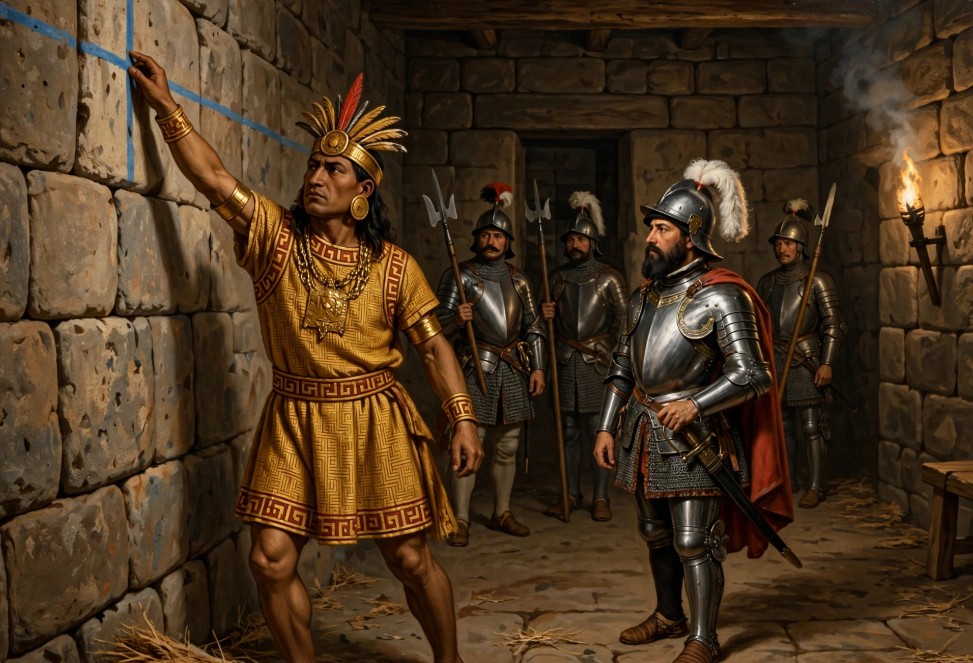
- Height: multiple eyewitnesses described him as towering over other men. The famous mark left in the Ransom Room—still visible today—stands at 2.25 meters (7 feet 4 inches). According to the chroniclers, Atahualpa himself raised his arm and marked the wall at that height. Based on standard anatomical proportions (the reach of a raised arm is roughly one-quarter of a person’s height above their standing height), his stature has been calculated at roughly 1.83 meters (about 6 feet). For comparison, the average height at the time for an ordinary Andean commoner was ~1.55 m (5’1″), while the Spaniards themselves averaged ~1.65 m (5’5″). In other words, Atahualpa towered over both groups by a significant margin.
- Complexion: noticeably lighter than that of other Indigenous individuals.
- Context: the Inca Empire was a major power for only about 90 years (~3 generations) before the Spanish arrived—far too short a window for nutritional selection to produce such a dramatic gap.
Dismissing these accounts as “exaggeration” is an act of faith, not scientific method.
4. The Golden Egg Myth and the Transcontinental Pattern
The Andean foundational myth is not a naive legend: it speaks of two distinct origins:
- Common people: from the copper egg.
- Ruling elite: from the golden egg.
The Incas did not consider themselves equal to their subjects. They were a biologically closed caste that practiced strict endogamy. And their own chronicles—compiled by Cieza de León, Sarmiento de Gamboa, and others—insist that Viracocha—the civilizing god—was white, bearded, tall, and emerged from Lake Titicaca to bring order out of chaos.
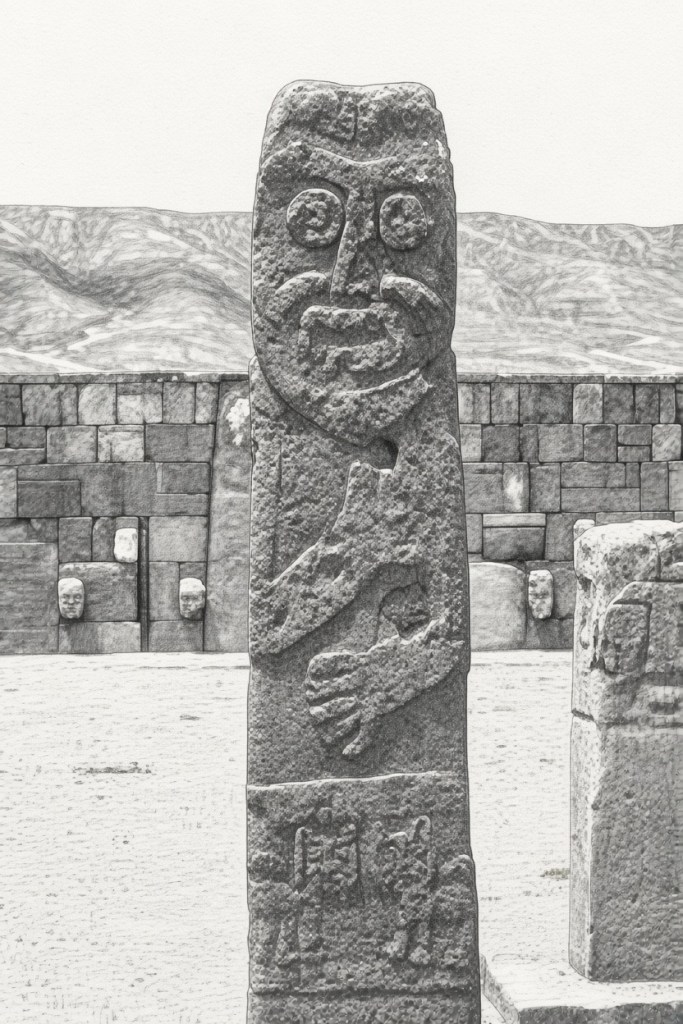
(Bearded monolith depicting the god Contiti Viracocha of the Tiahuanaco culture, dating back an estimated 1,500 to 2,000 years. This corroborates the historical accounts compiled by 16th-century Spanish chroniclers regarding the god Viracocha.)
But it is not just Peru. In Mexico, the exact same pattern appears:
- Quetzalcóatl: white, bearded, tall, bearer of knowledge, who promised to return.
- Viracocha: same archetype, same promise, same civilizing function.
Two cultures separated by thousands of miles, with no known contact, sharing the same myth of an anomalous being who founded their civilization.
Mainstream scholarship calls this “coincidence.” But a pattern that repeats systematically ceases to be coincidence and becomes a signal.
5. What Does the Study Actually Say? (And What It Does Not)
| What it says | What it DOES NOT say |
|---|---|
| The Y-lineages of 19 modern individuals are Andean | That the original Inca was “ordinary” |
| There is a high rate of extra-paternity | That modern genetics reliably reflect the Inca’s |
| No Amazonian or European lineages were found | That no admixture occurred before the conquest |
| The royal panaca origin is locally Andean | That the Incas lacked exceptional physical traits |
The study is weak, not fraudulent. But its weakness is turned into dogma because it fits neatly with the dominant Bayesian prior.
6. The Golden Rule of History: The Eyewitness Outweighs Statistical Inference
In historical research, the primary source carries fundamental weight. The conquest chroniclers were not fantasy novelists; they were soldiers and notaries filing official reports to the King of Spain.
Primary documentation:
- De Jerez, Francisco (1534): True Account of the Conquest of Peru. (First physical description of Atahualpa).
- Cieza de León, Pedro (1553): Chronicle of Peru. (Testimonies of Cusco amautas on Viracocha).
- Pizarro, Pedro (1571): Account of the Discovery and Conquest of the Kingdoms of Peru. (Eyewitness observations on Atahualpa’s stature and features).
- Díaz del Castillo, Bernal (1632): True History of the Conquest of New Spain. (Description of Moctezuma as a normal human).
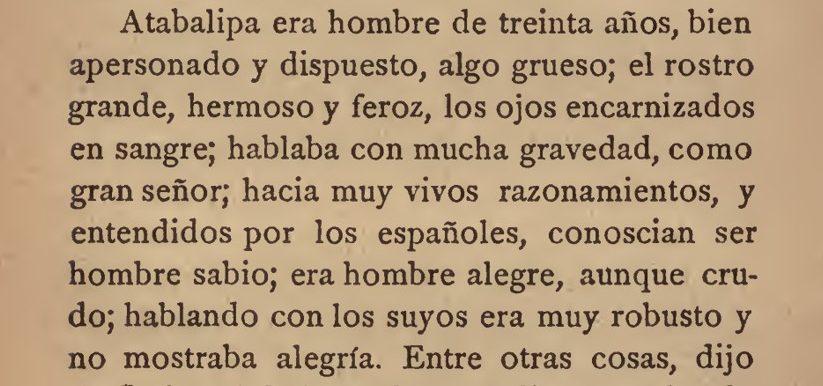
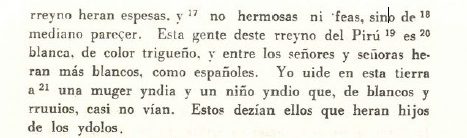
Against this, the genetic study offers 19 saliva samples from 21st-century individuals, with no mummies, no ancient DNA, and 500 years of admixture.
Who deserves more credence? The men who were there, who saw Atahualpa with their own eyes, who recorded the mark that the Inca himself left in the Ransom Room—a mark that still stands at 2.25 meters (7 feet 4 inches), made by his own raised arm—and who documented his towering stature before a notary.
7. Final Conclusion
I am not claiming the Incas were extraterrestrials.
I am claiming that:
- The genetic study does not prove they were “ordinary Andeans” in the sense of standard native peasants.
- Eyewitness accounts say otherwise.
- The Bayesian statistics used in these analyses start from a prior that categorically excludes any unconventional explanation.
- The transcontinental pattern of the bearded, tall, white civilizing god myth is a historical anomaly that a modern saliva test cannot erase.
Author’s Closing Note
“I do not know who the Inca elite really were. But I do know that the answer is not to be found in a study of 19 saliva samples from 21st-century individuals who cannot even prove their own lineage. The establishment has decided the question is closed. I believe that, as Bayes himself would remind us, when the prior is so strong that no evidence can update it, we are no longer doing science—we are practicing apologetics for a dogma. And dogmas, whatever their source, do not deserve to be called truth.”


Leave a Reply