What if the past isn’t a graveyard of memories, and the future isn’t a blank slate? What if time is actually a matter of cosmic geography?
We’re trapped in a scientific paradigm that, while useful for building washing machines and smartphones, has become completely stifling when it comes to understanding the deepest mysteries of existence. We’ve been indoctrinated with Karl Popper’s dogma of falsifiability: a rigid wooden ruler that dictates if something can’t be brought into a lab, controlled, repeated, and torn apart at human whim, then it simply doesn’t exist—or it’s labeled “pseudoscience.” It’s a cookie-cutter approach designed to see only the commonplace, only what fits inside the box.
But reality keeps overflowing that box. And paradoxically, quantum physics itself has left a crack through which a colossal truth is beginning to shine.
The Quantum Eraser: When the Lab Runs Out of Answers
You’ve probably seen videos on social media making sensationalist claims like, “Quantum physics proves your past still exists and that many realities coexist.” Mainstream scientists quickly deploy conceptual band-aids, filling their lectures with restrictive caveats to protect their outdated paradigm. They tell us the famous Delayed-Choice Quantum Eraser Experiment is just a “mathematical illusion” or a quirk strictly limited to the microscopic world.
But if we strip away those filters imposed by a fear of the unknown, the direct interpretation of the experiment is devastating: particles alter their behavior in the present based on a measurement that will happen in the future. There’s no retrocausality and no magic; what the experiment actually proves is that linear time is a biological illusion. The past and the future are already physically there, embedded in the fabric of reality.
The Concentric Spheres Model: A Fractal Multiverse
To understand this without the blinders of mainstream dogma, let’s picture the cosmos not as a line moving forward, but as a pond after a stone hits the water (the Big Bang). Except, whereas the ripples on a pond expand across a flat two-dimensional surface, in our fundamental universe we’re looking at these waves in at least four dimensions (three spatial dimensions and one of time).
Every expanding three-dimensional wave is a concentric sphere. The space separating one sphere from another is what we call a universe. Under this framework:
- Radius is Time: The smaller spheres closest to the center are the past. The outermost, massive, ever-expanding spheres are the future.
- Surface is Space: Our universe appears flat to us due to a simple matter of scale. We’re so incredibly tiny riding the surface of one of these massive spheres that its curvature is imperceptible to us; a tangent line to the sphere feels practically like a flat plane.
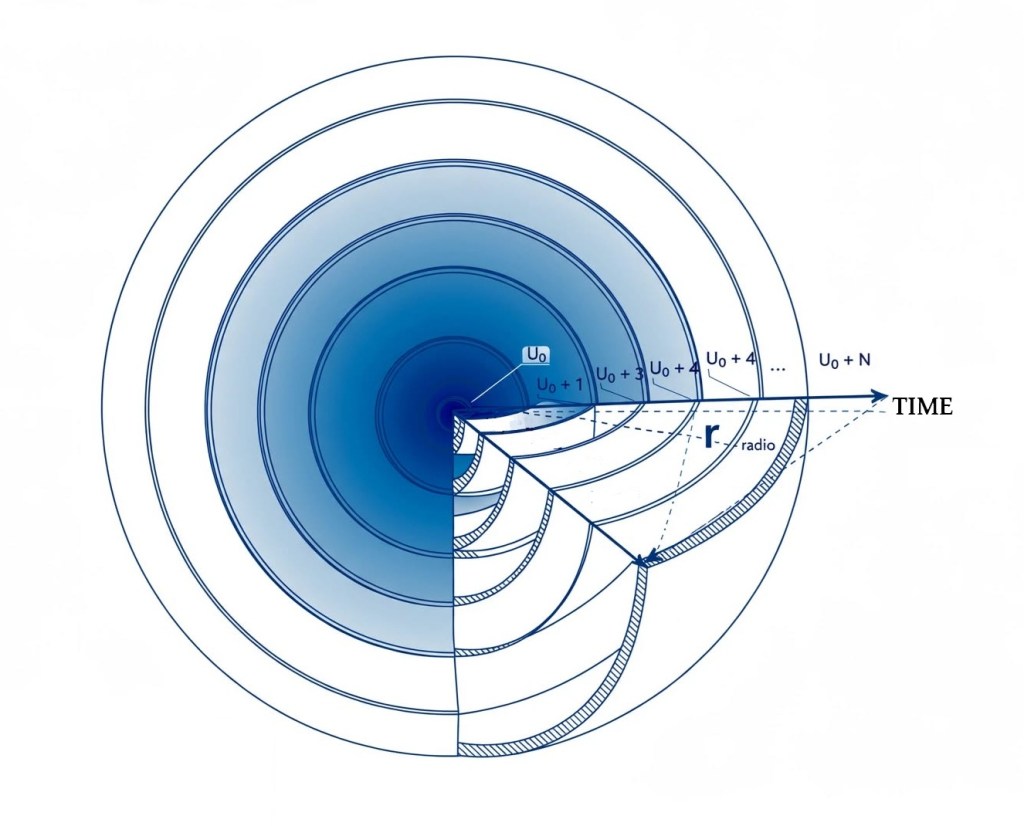
Through this lens, the future isn’t being built on the fly. The future already exists as a geographical coordinate on an outer layer.
How else do you explain people experiencing hyper-accurate, millimetric premonitory dreams? It’s not a psychological glitch, nor is it “confirmation bias.” It’s consciousness—which isn’t trapped inside the physical brain—acting as an antenna. When the noise of the three-dimensional world shuts down during sleep, that antenna briefly tunes into the frequency of an outer sphere.
The Fate of the Ripple and True Free Will
Anyone who has firsthand experience dreaming the future and watching it play out with pinpoint accuracy knows something textbook scientists will never grasp: when you try to physically alter that future event, the wave breaks anyway. The event takes place inevitably. Does that make us mindless robots stripped of freedom? Not at all.
Just like the initial energy of a stone dropped in water mathematically locks in the destiny of a small ripple—which will inevitably grow, expand, and dissipate without a single water molecule being able to stop it—each sphere holds the immutable blueprint of its own time.
Where does that leave free will and theology? This is where the fractal model becomes absolute perfection:
- Divine Omniscience: A hyper-dimensional consciousness (God), positioned entirely outside the pond, observes all concentric spheres simultaneously. This observer sees the impact, the small ripple, the medium wave, and the final dissipation all at once. Every choice we make across every layer is known, because to the Ultimate Observer, time is a static, eternal object.
- The “You” of the First Wave: Our free will doesn’t come from trying to change the wave we’re currently trapped in from inside the three-dimensional script. True free will exists because we are the authors of the very first wave. We coexist across all times at once; the “You” of the future universe has already made the decisions and crystallized reality on that outer layer.
Understanding this fractal multiverse is a lot like dealing with repeating fractions and infinite decimals. For instance, 1/3 = 0.333333…, exists completely within the vastness of mathematical infinity. Yet, at specific points, it materializes and condenses into a solid, tangible reality (like 0.33 or 0.333).
It’s time to stop listening to the dogmatic gatekeepers trying to measure the cosmos with wooden rulers, and start looking at the entire fractal. Quantum physics isn’t broken; what’s broken is the mold we use to force it into place, even when we regularly witness staggering truths that our current scientific paradigm is utterly powerless to disprove.
Postscript: Emerging Frameworks in Modern Physics
If you think this model is purely speculative, it is worth noting that a growing, highly specialized circle of physicists and philosophers of science are already building formal mathematical frameworks that challenge linear time to solve quantum paradoxes. The rigid, one-way cage of traditional causality is slowly cracking under the weight of peer-reviewed data.
- John Cramer’s Transactional Interpretation (1986): Inspired by the Wheeler-Feynman absorber theory, Cramer posits that quantum events are a physical “handshake” across time. An emitter sends a retarded wave (moving forward into the future), while a future absorber sends back an advanced wave (traveling backward into the past). The physical reality we observe is the result of these overlapping waves.
- Yakir Aharonov and Lev Vaidman’s Two-State Vector Formalism (TSVF): This time-symmetric approach describes a quantum system at any given moment using two vectors simultaneously: one evolving forward from the past, and another evolving backward from the future. In TSVF, a future boundary condition plays a real, mathematically active role in defining the physical present.
- Huw Price and Ken Wharton’s Retrocausal Models: Price (a philosopher of physics) and Wharton (a physicist) actively develop models showing that Bell correlations—the famous “spooky action at a distance”—can be explained without messy non-locality if we accept retrocausality. By allowing the future choice of a measurement to influence the past state of a particle, they rescue Einstein’s dream of a local, geometrical universe.
References / Academic Sources
Aharonov, Y., & Vaidman, L. (2007). The two-state vector formalism: An updated review. In J. G. Muga, R. Sala Mayato, & I. L. Egusquiza (Eds.), Time in Quantum Mechanics (pp. 399–447). Springer. https://doi.org/10.1007/978-3-540-73473-4_13
Cramer, J. G. (1986). The transactional interpretation of quantum mechanics. Reviews of Modern Physics, 58(3), 647–687. https://doi.org/10.1103/RevModPhys.58.647
Kim, Y.-H., Yu, R., Kulik, S. P., Shih, Y., & Scully, M. O. (2000). A Delayed Choice Quantum Eraser. Physical Review Letters, 84(1), 1–5. A Delayed Choice Quantum Eraser. [1, 2]
Price, H., & Wharton, K. (2023). Bell correlations as selection artefacts. arXiv preprint arXiv:2309.10969. https://arxiv.org/abs/2309.10969
Wheeler, J. A. (1978). The “Past” and the “Delayed-Choice” Double-Slit Experiment. En A. R. Marlow (Ed.), Mathematical Foundations of Quantum Theory (pp. 9–48). Academic Press.


Leave a comment