Why military data and quantum physics prove that real crafts are cylinders and “Tic-Tacs”
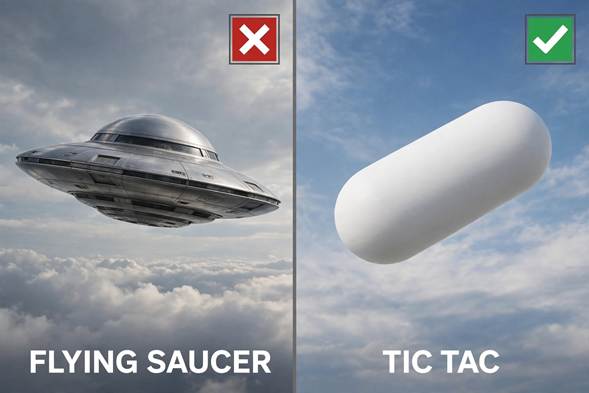
Pop culture has been obsessed with the wrong geometry for nearly a century. When the collective mind pictures non-human technology, it immediately draws a disk: the classic “flying saucer.” However, this concept does not hold up under rigorous analysis. The discoid shape is nothing more than a media-driven myth deeply rooted in society. From the perspective of theoretical physics and frontier engineering, the flying saucer is a structurally unfeasible absurdity, completely inefficient for interstellar or transmedium travel.
By scrubbing databases of folkloric interpretations and historical errors, a coherent technological pattern emerges—one backed by military aviators, commercial pilots, and advanced telemetry systems. Hard data points to an optimal geometric ecosystem rooted in the laws of physics: the cylinder family (barrel, spindle, or “Tic-Tac” shapes) and autonomous spheres.
Below, we will break down how the noise that shaped the saucer myth originated, how the declassification of modern data rewrote the rules, and why General Relativity and Quantum Mechanics utterly dethrone the disk in favor of cylindrical and spherical bodies.
1. The Genealogy of Noise: The Origin of the Popular Myth
To understand why the world became obsessed with “saucers,” we must dismantle two massive layers of historical distortion.
The 1947 Press Translation Error
On June 24, 1947, civilian pilot Kenneth Arnold was flying over the Cascade Mountains near Mount Rainier searching for a missing aircraft. He spotted 9 objects flying in formation. He explicitly described them as being “boomerang or crescent-shaped,” about 15 to 20 meters across, highly reflective, and traveling at over 1,900 km/h (1,200 mph).
Upon landing in Pendleton, Oregon, he intended to report the sighting to the FBI, but the office was closed, leading him to the newsroom of the East Oregonian newspaper. There, journalists Nolan Skiff and Bill Bequette asked him how the objects moved.
Arnold replied: “They flew erratic, like a saucer if you skip it across the water.”
Bequette sent the wire to the Associated Press (AP), and in the second paragraph, he wrote: “saucer-like aircraft.” He confused “the shape of the movement” with “the shape of the object” [1]. The AP and United Press (UP) picked up the story, and within a week, the U.S. went from zero to over 850 reports of “flying saucers.” Arnold himself later had to clarify: “They said I’d said they were like saucers; I said that they flew in a saucer-like fashion.”
That single error cemented the public imagination. This is why serious modern ufology no longer uses the term “saucers,” but rather UAPs (Unidentified Anomalous Phenomena) with cataloged morphologies: sphere, cylinder, tic-tac, spindle, and triangle.
The Anthropological Noise
Decades later, influential catalogs like Jacques Vallée’s Passport to Magonia mixed real physical incidents with folklore (fairies, elves). Because they lacked the speculative theoretical physics to filter the data, as well as the phased-array radar telemetry and military thermal signatures (FLIR) to properly record hard data, these catalogs amassed anthropological noise, heavily diluting the physical and geometric core of the phenomenon.
2. The Modern Tipping Point: The Five Observables
The stagnation ended with the emergence of declassified military telemetry. The undeniable catalyst was the 2004 USS Nimitz Incident [2], where the phenomenon was simultaneously tracked by the fleet’s radars and intercepted by the ATFLIR pods of F/A-18 fighter jets.
Based on these encounters, analysts systematized the Five Observables, the minimum physical parameters denoting advanced technology:
- Sudden Acceleration / Extreme Maneuverability (pulling in excess of 75g).
- Hypersonic Velocities without generating associated physical signatures.
- Low Observability: Cloaking or jamming against conventional sensors.
- Transmedium Travel: Operating in space, the atmosphere, and underwater without structural compromise [3].
- Positive Lift without Visible Propulsion.
When applying this filter to the global database, the objects exhibiting these consistent signatures are not saucer-shaped: they are shaped like cylinders, spindles, or spheres.
3. The Theoretical Analysis: Why the Saucer Fails the Physics Test
If we subject the flying saucer design to the laws of advanced theoretical physics (the Alcubierre Metric and quantum phase transitions), the disk collapses as an engineering option.
A. The Saucer’s Failure in Local and Transmedium Travel (The Alcubierre Metric)
To operate on a planetary scale, a craft must warp spacetime (the Alcubierre Metric), generating an isolation bubble using negative exotic mass [4].
- Massive Energy Drain: The physics of warp metrics proves that the amount of energy required scales disastrously depending on the frontal cross-sectional volume of the bubble [5]. A flat saucer moving horizontally requires generating a massive, wide bubble, resulting in an exponential and useless waste of energy.
| The 1994 Alcubierre metric is ds2 = -dt2 + [dx – vs f(rs) dt]2 + dy2 + dz2, where f(rs) is the shaping function of the bubble. The core concept is not that the ship moves, but rather that space contracts in front of it and expands behind it, leaving the ship inside a flat, unwarped internal region. The metric itself does not demand a specific ship shape; it demands a distribution of exotic energy. However, subsequent engineering studies show that shape is critical to the energy cost: – A spherical or wide-disk bubble requires an amount of negative energy on the order of Jupiter’s mass. This is unfeasible. – Van den Broeck demonstrated that by stretching the bubble into an elongated shape, like a cylinder or a rugby ball with a ring around it, the energy requirement is reduced by a factor of 106. – Recent models from 2021-2025 (Lentz, Bobrick-Martire, and the Applied Physics group) search for positive-energy solitons. They all converge on the same conclusion: the most stable and lowest-energy configuration is “elongated along the axis of motion”—i.e., a cylinder, cigar, tic-tac, or spindle. A wide, flat disk is the worst possible geometry because it maximizes the frontal area that must warp space and generates instabilities at the bubble’s edge. In other words, a saucer would have to push more space aside laterally than frontally. Aerodynamically and warp-dynamically, it is profoundly inefficient. |
- Transmedium Incompatibility: If the bubble fluctuates within a dense fluid (ocean), the saucer presents massive asymmetrical drag, subjecting the disk to physical stresses that would compromise its structural integrity.
B. The Saucer’s Failure in Intergalactic Travel (The Baryonic-Tachyonic Mechanism or Revoredo Model)
To cross galactic distances, the speculative theoretical framework of the Revoredo Model proposes transmuting baryonic matter into tachyonic matter [6]. For the ship’s information to survive, it requires a Phase Memory Tensor sustained by quantum symmetry [7].
- Quantum Phase Loss: A saucer expands its mass outward toward thin, sharp edges. These edges act as zones of high geometric divergence and phase loss. This would misalign the quantum information, disintegrating the molecular cohesion of the matter at the extremities upon reverting to a normal state.
| The Revoredo Model, unlike Alcubierre (which deforms space), proposes altering the nature of the matter itself, converting baryonic matter (real mass, m2>0) into tachyonic matter (imaginary mass, m2<0) to access hyperspace. This is achieved by inducing a topological transition based on Sen’s rolling tachyon formalism and the manipulation of compactified dimensions (Calabi-Yau). The greatest challenge of this model is not traveling, but surviving the transition without the ship’s atoms and its crew losing their structural identity. This is where the geometry of the ship is everything. Why is the disk lethal in the Revoredo Model? (The Collapse of PT Symmetry) For an object to maintain its molecular cohesion while becoming tachyonic, the model dictates that the system must be governed by PT-Symmetric Quantum Mechanics (Bender and Boettcher’s Parity-Time Symmetry). The strict mathematical condition for the crew’s survival is that the spectrum of the Hamiltonian HR must remain entirely real: Spec[HR(t)]⊂R For this equation to hold, the Phase Memory Tensor (PMT), denoted as Mμν , must remain stable throughout the entire ship. The problem with a “flying saucer” lies in its topology: – A disk or saucer has thin, sharp, and asymmetrical edges (the cross-sectional area decreases abruptly toward the extremities). – In quantum mechanics and string topology, sharp edges generate divergence points. When applying the Calabi-Yau torsion field (Tabc) to change the phase of matter, the edges of the disk act as “leakage zones.” – Mathematically, at the edges of the saucer, PT symmetry is broken (spontaneous symmetry breaking). The eigenvalues of the matter become complex: En→En ± iΓn (con Γn>0). – Physical Consequence: At the edges of the saucer, the physical norm dissipates. The relational matrix Cij that encodes the identity of the atoms collapses (decoherence). If you attempt to jump into hyperspace in a saucer, the center of the ship might survive, but the disk’s periphery and any crew members near the edges would disintegrate into a quantum soup upon losing their informational map. |
4. The Anatomy of the Cylinder and the Sphere (UAP Geometry Hierarchy)
Faced with the failure of the disk, frontier physics crowns the axial symmetry of the cylinder and the isotropy of the sphere. There are three genuine technological shapes, categorized by function:
1. The Pure Straight Cylinder (Motherships > 100 meters)
Designed as massive ships with parallel walls and flat ends.
- Absolute Quantum Stability: Lacking sharp curves, the force lines of the phase tensor run in perfect geometric parallelism, ensuring a stress-free quantum environment for matter transition [7].
- Ergonomics: This layout allows for flat decks to be stacked horizontally along its main axis (much like a skyscraper), optimizing the use of baseline artificial gravity generated by negative mass [8].
2. The Rounded Spindle or “Tic-Tac” (Local Transport / 10-15 meters)
A cylinder with rounded ends (fusiform shape).
- Alcubierre Optimization: Traveling along its longitudinal axis minimizes its frontal cross-section. It requires the tightest, narrowest warp bubble possible, drastically reducing the required energy [4][5]. This also smooths out air-to-water transmedium transitions [3].
3. Spheres (Drones and Autonomous Probes < 3 meters)
- Multidirectional Isotropy: A sphere possesses continuous O(3) symmetry [10]. A miniaturized warp drive inside a sphere can orient the spatial bubble across any 360° vector instantly. It does not need to physically rotate its chassis to execute orthogonal turns at Mach 10 [9].
- The Uninhabitable Core (Unfit for crew): The confinement forces of the warp bubble converge symmetrically toward the exact center of the sphere, creating a hyper-dense stress point (a pressure singularity). Biology could not survive there, which is why spheres operate strictly as advanced robotic probes.
5. The Evidence Record: Noise-Free Historical Cases
Once the media myth is purged, the timeline identically documents cylindrical-spherical physics and geometry throughout the years:
- 1896 (Oakland) & 1897 (Kansas): Thousands of citizens reported cylindrical bodies (“metallic cigars”) projecting searchlights over the bay.
- 1944 (Foo Fighters): Luminous spherical probes measuring 1 to 2 meters reported by WWII aviators, validating the isotropic design of these drones [9].
- 1948 (Chiles-Whitted Case, USA): DC-3 pilots witnessed a perfectly cylindrical, wingless torpedo-shaped object that accelerated while defying inertia (investigated by Project Sign) [11].
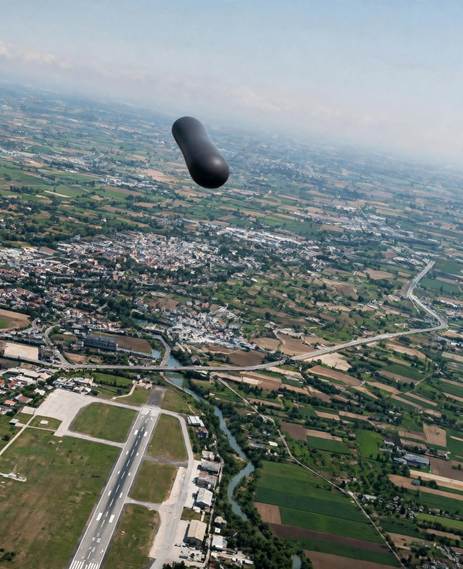
(Recreation of UFO photographed by Italian pilot Giancarlo Cecconi, 1979)
- 1977 (Operation Prato, Brazil): In declassified reports, Captain Uyrangê Hollanda described two specific geometries, expressly ruling out the saucer. First, he documented autonomous probes (approx. 1.2 meters) shaped like a cylindrical barrel or oil drum. Second, he described a colossal mothership (approx. 100 meters long) shaped like a spindle or “American football.” This massive craft emitted a dull hum (like a giant air conditioner) and evidence documented pure transmedium capabilities in the Amazon estuary [12].
- 2004 (Nimitz) & 2013 (Aguadilla): Commander David Fravor and multiple sensors confirmed smooth, rounded cylinders (“Tic-Tacs”) measuring 12 meters (40 feet), pulling instantaneous +75g accelerations and executing continuous transmedium dives [2][3].
Conclusion
The “flying saucer” is a media myth born from a 1947 press error, definitively debunked by historical military archives and modern reports. When we cross-reference declassified evidence (Nimitz, Prato, Chiles-Whitted) with peer-reviewed theoretical physics (volume optimization in the Alcubierre metric and information conservation via quantum symmetry), the cylinder and the spindle (Tic-Tac) are mathematically proven to be the only viable structural geometries for efficient transmedium and interstellar transport. Likewise, symmetric topology dictates that spheres are the optimal design for autonomous probes, confirming a technological ecosystem guided strictly by hard physics and engineering, rather than science fiction.
In short, the flying saucer would never be used by Type II or III Kardashev civilizations, because in:
- The Alcubierre Metric (Local Subluminal Travel): The saucer fails because it exponentially increases the cross-section, requiring absurd negative energies on the order of Jupiter’s mass. The Tic-Tac/Cylinder succeeds because it minimizes the frontal volume and energy drain (Van den Broeck).
- The Revoredo Model (Quantum Hyperspace Jump): The saucer fails because its sharp edges break PT Symmetry and destroy the Phase Memory Tensor (Mμν), disintegrating the crew at the extremities. The Cylinder succeeds because its axial symmetry and parallel walls maintain topological confinement, saving the ship’s quantum information.
Bibliographic References and Theoretical Foundation
[1] The Origin of the “Saucer” Error: Ruppelt, E. J. (1956). The Report on Unidentified Flying Objects. (Documents how the press distorted civilian pilot Kenneth Arnold’s 1947 report of a “crescent/boomerang” shape).
[2] The Nimitz “Tic-Tac”: U.S. Department of Defense. (2004). Unidentified Aerial Phenomena Executive Summary (USS Nimitz Incident Executive Report). Declassified.
[3] Transmedium Capability and Compact Spindles: U.S. Customs and Border Protection (CBP). (2013). FLIR Thermal Video Report of the Aguadilla, Puerto Rico Incident.
[4] Spacetime Propulsion: Alcubierre, M. (1994). “The warp drive: hyper-fast travel within general relativity.” Classical and Quantum Gravity, 11(5), L73.
[5] Geometric and Energetic Optimization: Pfenning, M. J., & Ford, L. H. (1997). “The unphysical nature of ‘Warp Drive’.” Classical and Quantum Gravity, 14(7), 1743. (Mathematically proves that the exotic energy requirement scales disastrously as the frontal cross-section of the bubble widens).
[6] Tachyonic Condensation (Matter vs. Hyperspace): Sen, A. (2002). “Rolling Tachyon.” Journal of High Energy Physics, 2002(04), 048.
[7] PT Symmetry and Identity Conservation in Cylinders: Bender, C. M., & Boettcher, S. (1998). “Real Spectra in Non-Hermitian Hamiltonians Having PT Symmetry.” Physical Review Letters, 80(24), 5243. (Establishes that conserving quantum information in non-Hermitian states requires unbroken geometric symmetries; completely incompatible with the divergent edges of a disk).
[8] Negative Mass Generation in a Lab: Khamehchi, M. A., et al. (2017). “Negative-Mass Hydrodynamics in a Spin-Orbit–Coupled Bose-Einstein Condensate.” Physical Review Letters, 118(15), 155301.
[9] Spheres as Autonomous Drones (Foo Fighters): USAAF 415th Night Fighter Squadron Reports (1944) and testimonies by Dr. Sean Kirkpatrick (AARO) before the U.S. Congress (2023).
[10] Spherical Maneuvering Isotropy: O(3) Symmetry Group in spatial topology, which grants continuous rotational symmetry, explaining the instant omnidirectional vector capacity of UAP probes.
[11] Pre-Pop Culture Cylinder Evidence: USAF Project Sign Archives / National Archives and Records Administration (NARA). Official report of the Chiles-Whitted Incident (July 24, 1948).
[12] Mothership Spindle and Cylindrical Probes (Colares): Official interview with Capt. Uyrangê Hollanda (1997) and Operação Prato reports (Brazilian Air Force, 1977). Declassified. (Expressly describes the 100m object as an “American football” and the local probes as “oil barrels”).


Leave a Reply