By José F. Revoredo
David Grusch’s recent statements on the Joe Rogan Experience have shaken the disclosure community. By claiming that certain intelligence reports mention the existence of “reptilian” races (over six feet tall with a gorilla-like build), “greys,” “insectoids,” and beings resembling “Greek gods,” the line between the serious study of aerospace phenomena and sci-fi shows (like Stargate and Star Trek: Enterprise) seemed to vanish entirely.
For many analysts, rather than aiding declassification, these kinds of testimonies taint the progress made before the U.S. Congress by Navy pilots, whose sightings are backed by radar and hard physical data. It feels like informational self-sabotage. But if we set aside sensationalist ufology for a moment, what do real science and our own cultural history tell us?
If we apply the laws of astrobiology, biomechanics, and the archaeological record, we will discover that while some of these morphologies have absolute physical and historical backing, others belong firmly to the realm of modern mythology.
PART I: The Inevitability of Humanoid Design (The Case for Greys and Nordics)
Many critics argue that expecting extraterrestrials to look like us is an anthropocentric bias. However, convergent evolution tells a different story. This phenomenon occurs when two distinct species in separate environments, yet subject to identical physical laws, develop the same anatomical solution (like the streamlined, hydrodynamic shapes shared by sharks and dolphins).
If an exoplanet is rocky, possesses liquid water, an oxygen-rich atmosphere, and Earth-like gravity, physics will impose strict constraints that favor the morphology of so-called “Greys” or “Nordics” for any intelligent being with abstract thought capable of creating space technology. This humanoid configuration rests on four unbreakable pillars of biological optimization:
1. The Number Two: Optimal Redundancy vs. Neural Cost
Evolution operates on a balance between redundancy (a failsafe against accidents) and processing cost. That is why we have two eyes, two ears, two arms, and two legs.
- Why not just one? (Vulnerability): A single eye eliminates depth perception (stereoscopic vision), making it impossible to manufacture complex tools. A single ear prevents the acoustic triangulation of danger. A single arm makes leverage and complex mechanical gripping impossible.
- Why not three or more? (The cerebral bottleneck): Adding a third hand requires a staggering amount of cerebral cortex dedicated exclusively to processing it. Controlling a motor limb involves millions of neurons firing simultaneously. A third arm would demand a much larger and heavier brain, driving the organism’s caloric consumption to unsustainable levels [Bainbridge, 2013]. Two is the perfect number.
2. Head Placement: Minimizing Signal Delay
Housing the senses and the brain in a spherical structure located at the highest point of the body responds to simple physical laws:
- Optical and Wave Physics: Elevating sensors exponentially expands the visual horizon and sound wave capture.
- Neural Conduction: Electrical impulses travel through axons at limited speeds (~100 m/s). If the eyes were in the chest and the brain in the head, reaction times would increase by critical milliseconds. Placing the sensors directly over the central processor minimizes signal delay [Schmidt-Nielsen, 1984].
3. A Single Mouth and Two Nostrils: Thoracic Efficiency
Having a single mouth centralizes the digestive system and saves vital thoracic space (already occupied by the heart and lungs), while also maximizing the mechanical leverage of the jaw. Meanwhile, two nostrils provide stereoscopic olfaction, allowing the organism to determine where a threat is coming from without turning its head.
4. The Center of Gravity and Bipedalism
Developing technology requires free prehensile hands, which forces an upright bipedal posture. In a ~1G environment, bipedalism demands perfect balance. Placing the reproductive system (and the gestating uterus) in the pelvis is pure mass engineering: if gestation occurred in the chest, the added weight would shift the center of gravity upward, causing the creature to topple over. The pelvis acts as a structural “safe box” right on the perfect axis of support [Cockell, 2018]. Furthermore, endothermy (warm-bloodedness) is mandatory: an advanced brain devours 20% of the body’s basal calories and requires a metabolism capable of auto-regulating its internal temperature.
PART II: The Backing of the Historical and Cultural Record
This humanoid pattern—scientifically validated—is not only a logical evolutionary response but is also deeply rooted in humanity’s oldest historical and religious records, where “gods” always shared our exact configuration:
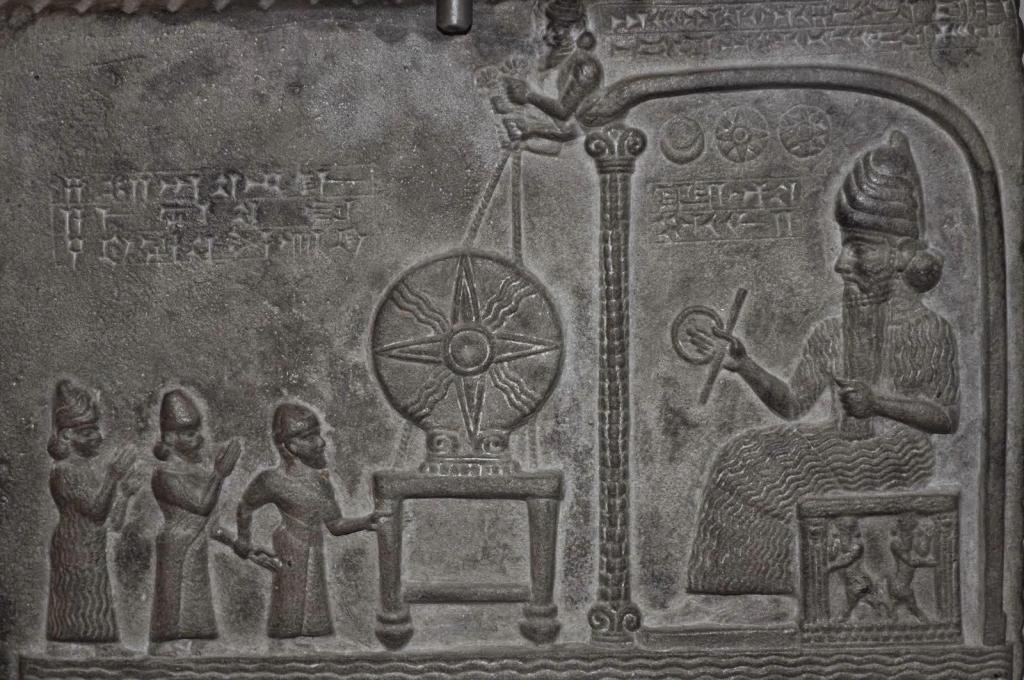
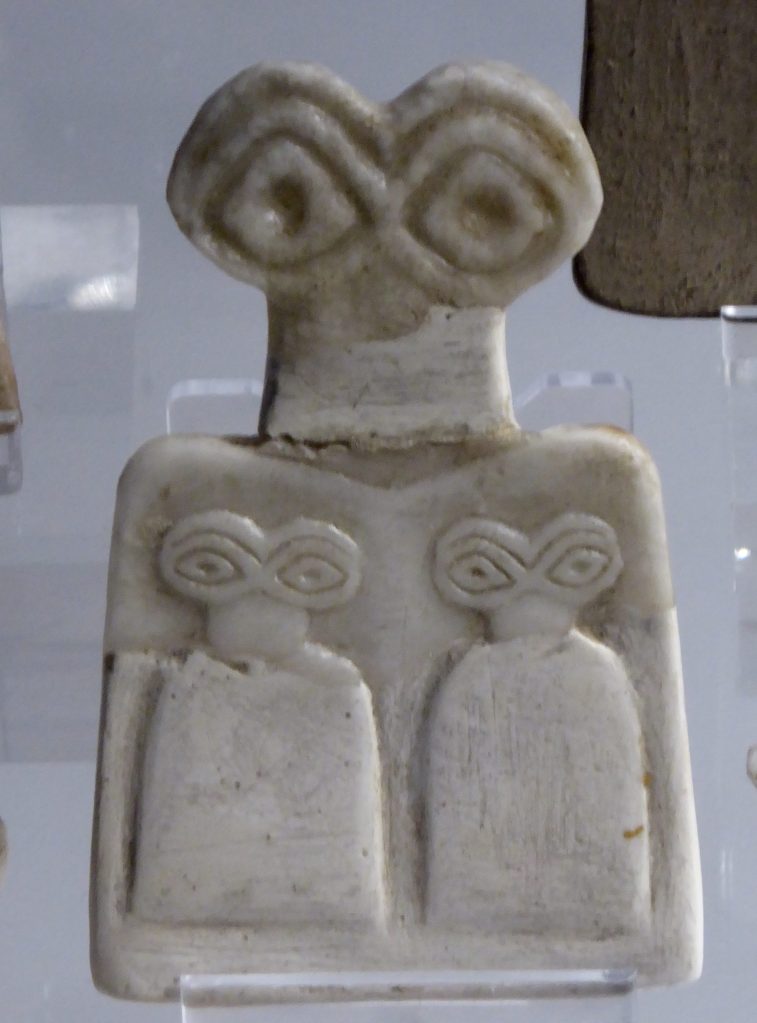
- Mesopotamia and the Igigi: In Sumerian tablets, the Anunnaki had human forms. The Igigi (lesser watcher deities, “those who see everything”) match a very specific representation. At the Eye Temple in Tell Brak (Syria), thousands of statuettes from the 4th millennium BCE were unearthed, featuring abstract faces dominated by massive, almond-shaped eyes—mirroring the classic aesthetics of the Greys.
- The White Gods of the Americas: Civilizing deities like Quetzalcoatl (Aztec), Kukulcan (Maya), Bochica (Muisca), and Con-Tici Viracocha (Inca) were consistently described as tall, fair-skinned, and bearded beings; the exact archetype that modern ufology associates with “Nordics” [Urton, 1999].

- The Caves of Australia: The ancient Aboriginal rock paintings of the Wandjina spirits depict humanoid figures with entirely white faces, no mouths, and enormous dark eyes. An exact portrait of the modern Grey.

At the roots of all human myth, true higher intelligence manifests under a modified humanoid baseline.
PART III: Physics vs. Myth (Why Reptilians and Insectoids Are Impossible)
While science supports humanoids, it also ruthlessly dismantles the modern science fiction archetypes that have seeped into American intelligence circles.
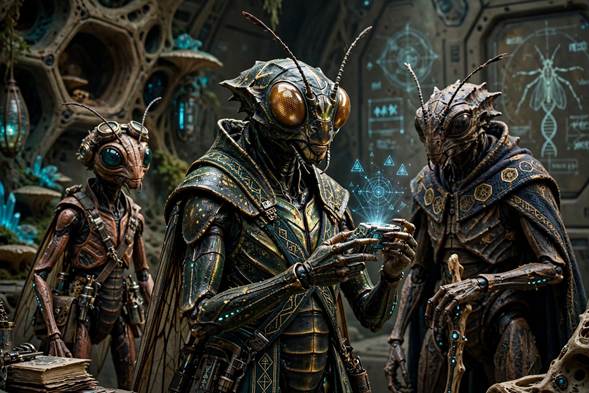
The Myth of Giant Insectoids
The idea of human-sized insects piloting spaceships crumbles under two unbreakable physical laws:
- The Square-Cube Law (Allometry): J.B.S. Haldane [1926] demonstrated that if we double an animal’s size, its surface area multiplies by 4, but its volume (weight) multiplies by 8. An insect scaled up to human size would collapse under its own internal mass, and its chitinous legs would shatter on the first step.
- Tracheal Asphyxiation: Insects do not have lungs; they breathe via passive diffusion through tubes. At a human scale, oxygen would take so long to reach the cells that they would suffer instant hypoxia. They would require minuscule gravity and atmospheres with over 40% oxygen, turning their planet into a highly flammable powder keg. On Earth, they would suffocate or be crushed.
The Myth of the Reptilians (The Metabolic Paradox)
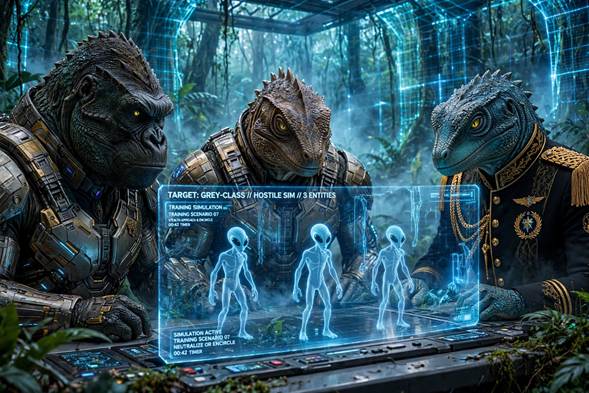
Reptiles are ectotherms (cold-blooded); they depend on environmental heat for their metabolism. An “intelligent reptilian” faces an insurmountable bottleneck: a massive, technological brain cannot simply power down or become sluggish when the temperature drops. A mere storm, a cloudy day, or winter would leave them in a lethal state of cognitive coma. A civilization requires operational consistency.
PART IV: The Ecological Paradox of an “Invasion”
If a detractor argues—in an attempt to save the myth—that “they come from a perpetual desert or tropical world,” this automatically breaks the logic of their visit to our planet. It creates a fundamental contradiction in the narrative of extraterrestrial interest:
- Biochemical Incompatibility: If their biology is hyper-adapted to a scorching planet (reptilians) or to super-oxygenated atmospheres and low gravities (insectoids), Earth—with its dynamic seasons, freezing zones, and standard atmosphere—would be a hostile, toxic, and uninhabitable refrigerator to them. Their enzymes would collapse.
- Cosmic Abundance: If a civilization has the technology to cross light-years, it doesn’t need to “invade” Earth for resources. The cosmos is brimming with asteroids and dead planets packed with frozen water, gold, and minerals, which can be extracted without having to deal with the gravity of an inhabited planet or with ecosystems that are poisonous to them.
VIABILITY SUMMARY TABLE
| Alien Type | Morphology / Biology | Scientific Viability | Verdict |
| Greys / Nordics | Humanoid, bipedalism, bilateral symmetry, endothermy. | High. Respects the laws of physics and biological optimization on Earth-like worlds. | Plausible / Backed |
| Insectoids | Chitin exoskeleton, passive tracheal respiration. | Zero. The square-cube law and the lack of lungs make them physically impossible at large scales. | Myth / Sci-Fi |
| Reptilians | Ectothermy (cold-blooded), scales, adapted to extreme climates. | Zero. Incompatible with high-energy-demand brains. Earth would be biologically hostile to them. | Myth / Psychological Projection |
CONCLUSION: Projections of the Human Mind
Hard science and history agree: physics sets the rules of the game across the entire universe [Cockell, 2018], and our own collective archaeological memory has left an exclusive record of magnified human forms interacting with us.
While the humanoid form has robust biophysical backing to develop on Earth-analog worlds, large-scale insectoid and reptilian figures belong firmly to the realm of cinematic mythology and franchises like Star Trek (Enterprise).
These exotic forms are nothing more than projections of human psychology cemented in 1950s pop culture: the fear of the soulless collective (the insectoid swarm) or the fear of the cold and treacherous (the reptilian predator). The fact that these sci-fi narratives are bleeding into today’s intelligence testimonies leaked by figures like David Grusch proves only one thing: either there is a massive disinformation campaign underway, or science fiction remains a profoundly powerful mental framework capable of contaminating the highest echelons of government.
Ufology must be scientific. And science dictates that the universe has biological rules that not even extraterrestrials can violate.
Scientific and Historical References
- Bainbridge, W. S. (2013). The xenobiology of intelligent life. Springer Science & Business Media. (Analyzes the limits of morphologies and how intelligence requires specific mass and energy parameters to avoid overwhelming the central nervous system).
- Cockell, C. S. (2018). The equations of life: How physics shapes evolution. Basic Books. (Demonstrates that the laws of physics dictate the shape of life in the universe, forcing heavy organs to be placed at the lower center of mass, making the humanoid form highly probable and ruling out unviable space monsters).
- Haldane, J. B. S. (1926). On being the right size. Harper’s Magazine, 152, 424-427. (The foundational historical essay on why insects cannot be large due to the physics of scale).
- Lineweaver, C. H., & Chopra, A. (2012). The cosmic biocentric principles and the convergence of life. Origins of Life and Evolution of Biospheres, 42(5), 453-461. (Theoretically supports how convergent evolution operates on a galactic level under the same chemical laws).
- Mallowan, M. E. L. (1947). Excavations at Brak and Chagar Bazar. Iraq, 9, 1-259. (Official archaeological reference on the Eye Temple of Tell Brak and its statuettes).
- Schmidt-Nielsen, K. (1984). Scaling: Why is animal size so important? Cambridge University Press. (Fundamental metric study on how a living being’s size conditions neural signal transmission, respiration, and skeletal structure).
- Urton, G. (1999). Inca myths. University of Texas Press. (Study on civilizing myths and the figure of Viracocha in the Andes).


Leave a Reply