THE TACHYONIC MECHANISM: A CONCEPTUAL GUIDE
(Copyright © 2026 José F. Revoredo)
This guide explains, in plain English, the Revoredo Model: a speculative theoretical physics hypothesis regarding how a ship could cross enormous distances by changing the fundamental nature of its matter. It pieces together concepts that physics already understands and assembles them into a logical chain. Some pieces are rock-solid, others are respected and actively researched theories, and a few are the model’s own postulates. None of this has been proven, and the engineering required to build it belongs to a civilization vastly more advanced than ours.
PART 1: THE 32 PRINCIPLES OF THEORETICAL PHYSICS USED BY THE MODEL
First, let’s take inventory. Each card explains the idea and its role in the model.
1. Special Relativity (Einstein, 1905)
- What it is: The theory that revolutionized our understanding of motion and light.
- How it works: Time and space aren’t a rigid, unchanging stage. If you travel very fast, time passes more slowly for you than for someone standing still, and distances physically shrink.
- What it means: The speed of light (c) is the universe’s ultimate speed limit for anything with mass. Imagine a built-in “speed governor” that prevents any material object from going faster than 300,000 km/s.
- How the model uses it: To establish the ultimate barrier that must be bypassed, since nothing with real mass can ever reach c.
2. General Relativity (Einstein, 1915)
- What it is: Our modern explanation of gravity.
- How it works: Forget Newton’s idea of an invisible “force.” Space and time form an elastic fabric (spacetime). If you place a heavy object on it, like the Sun, the fabric dips and curves.
- What it means: “Matter tells space how to curve, and space tells matter how to move.” The Earth orbits the Sun because it’s rolling along the curvature the Sun creates.
- How the model uses it: For its field equation (Einstein’s equation with added terms) and for the modified Revoredo metric.
3. Relativistic Energy Equation (Einstein-Lorentz)
- What it is: The math that links an object’s mass to its energy as it approaches the speed of light.
- How it works: It’s the full formula behind E=mc2. As an object accelerates, its energy and inertia increase. Reaching the speed of light would require infinite energy.
- What it means: If you plug a speed faster than light into the formula, you get the square root of a negative number. For the energy to remain a real, measurable number, the rest mass would have to be imaginary.
- How the model uses it: It’s the mathematical origin of the tachyon: if we allow v>c, the rest mass is purely imaginary (m0=iμ).
4. Imaginary and Complex Numbers
- What they are: An absolutely indispensable mathematical tool in modern physics.
- How they work: In grade school, we’re taught that the square root of −1 doesn’t exist. Mathematicians invented a number for exactly that: i, the imaginary unit. Combining real numbers (like 3) with imaginary ones (like 2i) gives you complex numbers.
- What it means: Even though they’re called “imaginary,” they are incredibly real in physics. In quantum mechanics, they describe waves and probabilities.
- How the model uses it: Tachyonic mass is purely imaginary. The model offers a philosophical analogy: imaginary numbers were considered “unreal” for centuries and are now essential. Therefore, what on our “real” axis is an “impossible mass” might just be the normal, stable vibration of another environment—hyperspace. It’s a mathematical analogy, not a proof.
5. Klein-Gordon Equation
- What it is: The first equation that tried to merge quantum mechanics with special relativity.
- How it works: It describes quantum particles with no spin. It includes a mass-squared term (m2).
- What it means: If m2 turns out to be negative, the universe doesn’t explode. In quantum physics, it just means the field is unstable, like a pencil perfectly balanced on its tip: it exists, but the slightest breeze will make it fall.
- How the model uses it: It’s the formal foundation of the tachyonic field. It uses m2<0 to describe the instability that kicks off the transition.
6. Higgs Mechanism (Spontaneous Symmetry Breaking)
- What it is: The process by which particles get their mass.
- How it works: Imagine the universe is filled with invisible “molasses” (the Higgs field). Some particles glide through it effortlessly (photons, which have no mass), while others have to drag themselves through it (electrons, which have mass).
- What it means: Physicists explain this using a graph shaped like a Mexican hat. The top center peak is unstable: a marble placed there is in an impossible balancing act and will “fall” into the brim, reaching a more stable, lower-energy state.
- How the model uses it: It’s the mathematical analog for tachyon condensation. With a unique twist: the engine actively holds the field inside the unstable zone of the hat (anywhere from the peak to the inflection point, where the curve changes shape)—an inhibited tachyon condensation—until it’s ready to let go
7. Tachyon Condensation (Sen, 2002)
- What it is: A process in string theory describing how an unstable system seeks equilibrium.
- How it works: Historically, a tachyon was thought of simply as a particle traveling faster than light. Today, it’s understood primarily as an instability: the marble on top of the hat starting to roll. In string theory, the very first string that popped out of the math had an imaginary mass. It wasn’t discarded as a glitch; it was interpreted as an unstable state of the system.
- What it means: It’s not about time-traveling to the past, but rather a change of state: a field rolling downhill until it finds a new stable state. According to Ashoke Sen, that final state is “tachyonic matter”: closed strings with zero pressure.
- How the model uses it: It acts as the dynamic engine of the transition. The field T(t) rolls down Sen’s potential, V(T)=τ/cosh(T/√2), shifting from a baryonic state into a tachyonic one.
8. String Theory
- What it is: A model attempting to explain what matter is made of at its most fundamental level.
- How it works: If you zoomed way in on an electron or a quark, you wouldn’t see a solid dot, but rather a vibrating loop or string.
- What it means: Think of a guitar: the exact same string produces different notes depending on how it vibrates. One vibration creates an electron, another creates a photon. A particle’s mass is literally “how” its string vibrates.
- How the model uses it: It’s the core of the mechanism: changing the strings’ mode of vibration is identical to changing the fundamental nature of the matter.
9. M-Theory / Superstrings (Witten, 1995)
- What it is: The unification of the five different string theories.
- How it works: In the ’90s, there were five competing string theories. Edward Witten proposed they were just different ways of looking at one larger, overarching theory. For the math to work, the universe needs 11 dimensions (3 of space, 1 of time, and 7 curled up microscopically).
- What it means: Our 3D universe might just be a flat sheet floating in a much larger space, known as “the bulk” (hyperspace).
- How the model uses it: It provides the hyperspace where the ship travels once it becomes tachyonic.
10. Calabi-Yau Spaces
- What they are: The specific geometric shapes of those extra dimensions.
- How they work: If string theory requires extra dimensions, where are they? They are curled up on themselves, so tiny we can’t see them, and they fold according to incredibly complex geometric rules called Calabi-Yau spaces.
- What it means: The exact shape of this microscopic “origami” dictates how the strings are allowed to vibrate, which in turn creates the laws of physics we observe.
- How the model uses it: The Revoredo Engine locally alters this geometry to force the strings to change how they vibrate.
11. D-branes
- What they are: Multidimensional surfaces where strings live, sort of like canvases.
- How they work: “Brane” comes from “membrane.” Our 3D universe would be a 3-brane. Open strings (the ones making up normal atoms) have their ends firmly anchored to this brane and cannot leave it.
- What it means: There are also closed strings, which are little loops with no ends (these are responsible for gravity). Because they aren’t anchored, they can easily slip off our brane and float away into hyperspace.
- How the model uses it: Baryonic (normal) matter consists of open strings anchored to our brane. Tachyonic matter consists of closed strings, flying freely in hyperspace.
12. Dirichlet and Neumann Boundary Conditions
- What they are: The math rules governing what happens at the ends of a string.
- How they work:
- Dirichlet: The ends are pinned down, anchored to the brane (like a tied violin string).
- Neumann: The ends are loose (like the loose end of a rope flailing freely).
- What it means: Shifting from Dirichlet to Neumann means unanchoring the string. A string with free ends can loop back and close on itself, forming a ring. A ring no longer needs to be anchored to a brane.
- How the model uses it: The Calabi-Yau torsion field flips the condition from Dirichlet to Neumann. Then, during the “loop closure,” the free ends fuse together. In an instant, baryonic matter stops being anchored.
13. Energy-Momentum Tensor (Tμν)
- What it is: General Relativity’s mathematical “inventory sheet.”
- How it works: It’s a grid of numbers telling Einstein’s equation exactly how much mass, energy, momentum, and pressure exist at every single point in space.
- What it means: It sits on the right side of Einstein’s equation and acts as the source of curvature. If you change its values—for instance, by inputting negative energy density—spacetime bends in highly unusual ways. Relativity responds to the overall tensor, regardless of what’s inside creating it.
- How the model uses it: The model’s goal is to make its time-component (T00) locally negative. It achieves this using the Revoredo Inversion Condition (see Phase 1).
14. Energy Conditions (The “Weak” one, WEC)
- What they are: Mathematical assumptions in classical physics, designed to keep equations from churning out chaotic results; they are not absolute laws.
- How they work: Physicists like Roger Penrose assumed that any observer should always measure an energy greater than or equal to zero. Today, we know nature happily violates this in specific regimes:
- Micro (quantum): The quantum vacuum violates it locally. The Casimir effect (Principle 15) proves this in the lab.
- Macro (cosmological): Dark energy, accelerating the universe’s expansion, also defies classical physics expectations. Some physicists even propose negative mass on a cosmic scale, though that remains a hypothesis.
- What it means: For years, people thought these rules strictly prohibited warp drives. Since they aren’t absolute, a locally negative T00 isn’t banned by principle.
- How the model uses it: To argue that a local T00<0 isn’t completely forbidden by nature. Unlike the Alcubierre drive, which requires literal negative mass (Principle 29), Revoredo achieves it through a different route: the Revoredo Inversion Condition.
15. Casimir Effect
- What it is: Empirical proof that empty space isn’t actually empty.
- How it works: If you place two tiny metal plates microscopically close together in a perfect vacuum, they get pushed together.
- What it means: Fewer quantum vacuum waves can fit between the plates than outside them, creating a pressure difference that pushes them inward. It proves that vacuum energy reacts to geometry and can be forced locally lower than normal.
- How the model uses it: It’s the inspiration for the energy extractor. The model postulates an analogous effect scaled up macroscopically to harvest vacuum energy. This is an assumption of the model, not an engineered reality yet.
16. Zero-Point Energy (ZPE)
- What it is: The universe’s minimum residual energy.
- How it works: Imagine a pendulum cooled down to absolute zero (−273.15 °C). In classical physics, it would stop completely. In quantum mechanics, it never stops: it always retains a baseline “jitter.”
- What it means: The vacuum is constantly boiling with fluctuations. It also presents a massive enigma: quantum physics predicts a vacuum energy value about 120 orders of magnitude larger than what cosmologists actually measure in space. It’s the biggest mismatch between theory and observation in all of physics, and it’s the exact territory where the model places its energy hypothesis.
- How the model uses it: It’s the ship’s fuel. The model assumes a highly advanced civilization could tap a minuscule fraction of it (maybe a volume the size of a grain of sand would be enough) to reach the Planck scale.
17. ER=EPR Conjecture (Maldacena and Susskind, 2013)
- What it is: A hypothesis that bridges two of physics’ greatest mysteries.
- How it works: “ER” stands for Einstein-Rosen bridges (wormholes), and “EPR” stands for quantum entanglement, where two particles become spookily linked regardless of distance.
- What it means: The conjecture suggests they are, deep down, the exact same thing: entanglement actually involves a microscopic wormhole geometry connecting the particles. Important: Entanglement cannot be used to send messages or energy. It only maintains correlations.
- How the model uses it: It’s the foundation for the non-local energy compensation between the ship and the Dyson Sphere (see the note below), for hyperspace positioning, and for the shared reference of the Phase Memory Tensor.
Note on the term “transmission”: In the Revoredo Model, the Revoredo-EPR Network does not shoot energy through space. The ship extracts zero-point energy locally, and the Dyson Sphere “pays” for that extraction in its own vacuum. Entanglement simply keeps both ledgers balanced non-locally. This is a postulate of the model, not a currently proven feature of entanglement, requiring tech that does not yet exist.
18. Density Matrix (von Neumann)
- What it is: The “quantum passport” of a system when absolute certainty is impossible.
- How it works: In basic quantum mechanics, a vector perfectly describes a single particle. A density matrix is a grid of numbers used to describe real, messy systems mixed and interacting with their environment.
- What it means: It allows physicists to fully describe the quantum state of something massive, like a spaceship, including all the delicate coherences (superpositions and entanglements) that hold it together as a single entity.
- How the model uses it: It’s the starting point for encoding the ship’s identity prior to the transition.
19. Wigner Function and Weyl Transform
- What they are: A bridge between the quantum world and the classical world.
- How they work: Quantum mechanics and classical physics use entirely different math spaces. The Wigner function takes a “blurry” quantum state and graphs it onto a chart of position and momentum (phase space). It can yield negative values, which is the dead giveaway of its quantum nature.
- What it means: It acts as an adapter, translating quantum states into a format that can interface with spacetime equations.
- How the model uses it: It serves as the intermediate step connecting the density matrix to curved spacetime.
20. Vierbein (Tetrad)
- What it is: A geometric translator.
- How it works: Imagine a flat map (Special Relativity) and a real, curved globe (General Relativity). The vierbein (German for “four legs”) allows you to stick a perfectly flat piece of paper onto any point on a curved surface so you can do math locally.
- What it means: It allows flat-space physics to operate locally inside highly curved spacetime.
- How the model uses it: It’s the final step to make the Phase Memory Tensor “covariant” (meaning it doesn’t break depending on your coordinate system), allowing it to successfully plug into Einstein’s equation.
21. Lindblad Equation
- What it is: The equation that describes how quantum magic leaks away.
- How it works: Quantum systems are incredibly fragile. If an atom bumps into a single air molecule, its quantum state collapses and it becomes “normal.” This is called decoherence, and the Lindblad equation mathematically maps out this information leak.
- What it means: It models the evolution of “open” quantum systems that interact with the outside world.
- How the model uses it: The active restoration term of the Phase Memory Tensor takes the form of a Lindblad equation but with its sign flipped: instead of destroying coherence, it actively restores it. This inversion is a postulate of the model.
22. PT Symmetry (Parity-Time)
- What it is: A quantum mirror trick.
- How it works: Parity (P) means flipping space, like looking in a mirror. Time (T) means running the clock backward. If you apply both and your equations still look identical, your system has PT symmetry.
- What it means: Sometimes, physicists encounter non-Hermitian Hamiltonians (Principle 32) that look disastrously unstable. But Bender and Boettcher (1998) proved that if these systems respect PT symmetry, and that symmetry doesn’t “break,” their energies remain totally real and stable. Bender, Brody, and Jones (2002) later showed that the system’s evolution remains unitary (meaning total probability is perfectly conserved) as long as you change the rulebook on how probabilities are measured (using the “CPT norm”).
- How the model uses it: The Hamiltonian of the tachyonic state is non-Hermitian, and PT symmetry guarantees its spectrum stays real and its evolution unitary. This ensures the ship’s identity doesn’t degrade. (Best read alongside principles 31 and 32).
23. Time Crystals (Wilczek)
- What they are: A perpetual motion quantum clock.
- How they work: A normal crystal repeats its structural pattern in space. A time crystal repeats its pattern in time, oscillating rhythmically and stably forever.
- What it means: It serves as a flawlessly stable clock reference and, theoretically, an almost perfect quantum memory. The ones we’ve created in modern labs are “driven” versions that require periodic laser pulses. The model assumes an idealized version, operating at its lowest energy state, using vastly superior technology.
- How the model uses it: They stabilize the tachyonic phase and hold the reference anchor for the Phase Memory Tensor.
24. Heisenberg Uncertainty Principle
- What it is: The fundamental law of universal fuzziness.
- How it works: It is physically impossible to know both the exact position and the exact momentum of a particle simultaneously.
- What it means: Nothing can ever be “perfectly still.” That’s why the vacuum is always fluctuating.
- How the model uses it: It provides the theoretical basis for the quantum vacuum fluctuations that feed ZPE.
25. Planck Scale
- What it is: The size of the universe’s “pixels.”
- How it works: Down at about 10−35 meters, the classical rules of space and time break down completely, and relativity collides violently with quantum mechanics.
- What it means: It is the absolute limit of current physical knowledge. Manipulating spacetime at this level requires terrifying amounts of energy: the Planck energy is roughly 2 billion joules per single string. That’s like taking the energy of a full tank of gas in a car (about 15 gallons) and squeezing it into a dot several trillion trillion times smaller than an atom. For comparison, our Large Hadron Collider (LHC) is about 15 orders of magnitude too weak to do this.
- How the model uses it: It’s the exact energy scale required to bend and alter strings. A Dyson Sphere would provide this kind of power.
26. Kardashev Scale
- What it is: A theoretical yardstick for measuring a civilization’s technological advancement.
- How it works: Type I harnesses all the energy of its home planet (humanity is currently around 0.7). Type II harnesses all the energy of its star. Type III controls the energy of its entire galaxy.
- What it means: It helps estimate the technological baseline required for insane mega-engineering projects.
- How the model uses it: It firmly places Revoredo technology in the hands of a Type II or Type III civilization.
27. Dyson Sphere
- What it is: A mega-structure originally proposed by Freeman Dyson.
- How it works: A massive structure (for example, a dense swarm of solar panels) built entirely around a star to capture 100% of its energy output.
- What it means: It’s the practical stepping stone to becoming a Type II civilization: basically a “gas tank” the size of a sun.
- How the model uses it: It reinterprets the sphere as a quantum infrastructure hub with three jobs:
- Providing the stellar energy to “pay” for the ship’s ZPE extraction.
- Stabilizing phases and coordinating massive particle entanglement.
- Acting as a central node in the Revoredo-EPR Network (handling energy, positioning, and holding the reference for the Phase Memory Tensor).
28. Wormholes (Einstein-Rosen)
- What they are: A theoretical shortcut through spacetime.
- How they work: Imagine an apple and a worm crawling from one side to the other. It can crawl all the way around the skin, or it can chew a tunnel straight through the middle.
- What it means: The equations of relativity allow them to exist, though traversable ones would be highly unstable.
- How the model uses it: It’s the underlying geometry that the ER=EPR conjecture attributes to entanglement. The ship does not fly through them.
29. Exotic Matter / Negative Mass
- What it is: Matter, or an altered state of matter, featuring bizarre, non-standard properties.
- How it works: Negative mass would have inverted inertia: if you pushed it away, it would accelerate towards your hand. Gravitationally, it would repel normal matter.
- What it means: The Alcubierre drive (the warp bubble) requires literal negative mass to work, which is its biggest roadblock: nobody has ever found any.
- How the model uses it: Revoredo avoids negative mass entirely. Its exotic matter is tachyonic (imaginary mass). In its final state (Sen’s tachyon matter), it possesses positive energy density and zero pressure. The local T00<0 comes purely from the Revoredo Inversion Condition, not from the final tachyonic matter itself.
30. Bose-Einstein Condensate (BEC)
- What it is: An extreme state of matter.
- How it works: If you cool certain gases down to almost absolute zero, their atoms clump together into the exact same quantum state, acting like one giant “super-atom.”
- What it means: It allows us to observe quantum effects on a macroscopic scale. In 2017, a team at Washington State University used lasers on a rubidium BEC to simulate an effective negative mass: the particles accelerated backwards when pushed. This was an effect of the system’s collective behavior, not actual repulsive gravity.
- How the model uses it: It doesn’t appear directly in the Revoredo chain. It is mentioned as context for the ongoing debate surrounding negative mass and Alcubierre.
31. Hermitian Hamiltonian Models
- What they are: The golden rule of quantum physics for stable, closed systems.
- How they work: A “Hamiltonian” is the mathematical engine that calculates a quantum system’s energy. If it is “Hermitian,” it strictly follows two rules: its energies are always real numbers, and total probability is always perfectly conserved at 100%.
- What it means: It perfectly describes a closed, isolated system, like a flawless bank vault: nothing gets in, nothing leaks out. This is how basic textbook particles are studied.
- How the model uses it: As long as the field T(t) is rolling and remains real, the Hamiltonian governing the transition remains Hermitian.
32. Non-Hermitian Hamiltonian Models
- What they are: The math for “open” quantum systems, where energy or information flows in or out to the environment.
- How they work: If you “open the vault,” the Hamiltonian stops being Hermitian, and its energies can spill out as complex numbers. Usually, this means something is decaying or leaking, which is why physicists traditionally distrusted these models.
- What it means: There are major exceptions (see Principle 22): if the system respects PT symmetry and it doesn’t break, the energies remain completely real.
- How the model uses it: Only when the ship reaches the fully saturated tachyonic state (m0=iμ) does the Hamiltonian become non-Hermitian. Without a fix, the ship’s state would rapidly degrade. The model proposes that this specific Hamiltonian is PT-symmetric: ensuring its spectrum is real and its evolution is unitary under the CPT norm. Its only failure criterion is the spontaneous breaking of PT symmetry: if that happens, eigenvalues turn complex and identity is lost.
PART 2: THE CONVERSION CHAIN, STEP BY STEP
The complete sequence, from sitting on the launchpad to returning home.
PHASE 0: PREPARATION. THE SHIP IN BARYONIC MODE
The ship is made of atoms, which are made of protons, neutrons, and electrons. All of these are open strings anchored to the 3D D-brane (Principle 11), with their ends pinned firmly in our reality (Dirichlet condition, Principle 12).
Its mass is positive (m2>0). It travels at subluminal speeds, trapped by Special Relativity (Principle 1).
The Revoredo Engine is off. In terms of the tachyonic field T(t), normal matter rests at T=0, the very peak of the Mexican hat (Principles 5 and 7), where the field’s effective mass squared is negative (the red flag of instability). But the matter is tightly anchored to the D-brane, so it doesn’t roll.
PHASE 1: ACTIVATION. THE REVOREDO INVERSION CONDITION
The engine ignites, and several things happen simultaneously.
The Energy: The engine locally extracts zero-point energy from the vacuum surrounding the ship (Principles 15, 16, and 24), using a macroscopic analog of the Casimir effect. Extracting this much from the vacuum would normally leave a massive “debt” that would destabilize the local system. Here’s where the Dyson Sphere and entanglement step in (Principles 17, 27, and 28): the Sphere injects stellar energy into its own local vacuum to “pay” that debt. It’s non-local cosmic accounting, not beaming energy through space (see the note in Principle 17). The scale required is the Planck scale (Principle 25).
The Revoredo Inversion Condition (RIC): The engine actively holds the field within the unstable zone of the potential—the slope from the hat’s peak down to the inflection point—meeting two conditions: the potential’s curvature is negative (V′′<0) and the potential’s energy grows over time (∂tV>0). This is an inhibited tachyon condensation: the field desperately wants to “fall,” but the engine props it up (Principles 6 and 7). Under this intense condition, the time-component of the energy-momentum tensor can become locally negative (T00<0), and General Relativity physically responds to that tensor (Principles 13 and 14).
The String Shift: The energy floods the Calabi-Yau Graphene Metamaterials (the string resonators), which locally warp the geometry of the curled-up dimensions (Principle 10). The resulting Tabc torsion field flips the boundary conditions: from Dirichlet (pinned ends) to Neumann (free ends) (Principle 12). With the ends now whipping free in hyperspace, the pressure of the torsion field forces them together in a “loop closure,” fusing the strings into themselves. They become closed strings (Principle 11).
This is the point of no return. The baryonic matter is ceasing to be baryonic.
PHASE 2: THE TACHYON TRANSITION. SEN’S ROLLING
With the strings now unanchored, the engine releases the field, and T(t) rolls down Sen’s potential, like the marble finally dropping from the unstable peak (Principles 5, 6, and 7). It’s the Higgs mechanism in reverse: instead of letting the field fall randomly, the model controls exactly when and how it drops.
- The strings stop vibrating in the “electron” or “quark” mode. They are drastically shifting their fundamental harmonic (Principle 8).
- At the inflection point, the field’s effective mass squared hits exactly zero: the instability is exhausted. This is the critical moment: for normal unanchored matter, hitting zero mass would trigger a catastrophic radiation explosion. But because the unanchoring already happened, the energy-momentum tensor cancels out its local confinement (Principle 13).
- Past the inflection point, the field’s effective mass is small, positive, and trending toward zero: the field is settling into its new state. As T → ∞, the potential V(T)→0. Energy density flatlines at a non-zero constant while pressure drops to absolute zero. This is Sen’s tachyonic matter regime: closed strings, zero pressure.
There are two ways to describe this exact same event. While the transition is happening, it’s described as a field (T is real, Hamiltonian is Hermitian, Principle 31). Once it finishes, it’s described as particles with imaginary mass (m0=iμ, Principles 3 and 4), governed by a non-Hermitian Hamiltonian (Principle 32).
Careful with the two distinct “masses.” The effective mass of the field,

measures how unstable the field is: negative at the peak, zero at the inflection. The imaginary mass m0=iμ is the mass of the particles in the final state. The first describes the journey, the second describes the destination.
The ship is no longer baryonic matter. It is now tachyonic matter, the specific exotic matter utilized by the model (Principle 29). It resides in hyperspace (Principle 9). All of this feeds into the Revoredo field equation: Einstein’s original equation (Principle 2) modified with terms for the phase operator, the zero-point energy, and the Phase Memory Tensor.
PHASE 3: THE CRUISE. TRAVEL IN HYPERSPACE
In hyperspace, the ship is composed entirely of closed strings (Principles 8 and 11). Untethered to any brane, it glides freely through the bulk.
Inverted Mechanics: Its natural resting speed is infinite, and its energy is at its absolute minimum. To steer or slow down, it must burn energy: less energy means faster speed. This is tachyonic inverted mechanics. For the crew, the trip feels virtually instantaneous: the hyperspace parameter (σ) completely decouples from real-space proper time (τ).
Identity: The Phase Memory Tensor (PMT) is active. It was defined right before the transition and meticulously encodes the full identity of the ship and crew: every atom, every firing neuron, every memory. It was constructed using the density matrix, the Wigner function, and the vierbein (Principles 18, 19, and 20). During the cruise, it evolves according to a three-part equation:
- A unitary evolution term (commutator with the Calabi-Yau Hamiltonian).
- An active restoration term that corrects deviations. It looks like a Lindblad equation but with a flipped sign: it actively restores coherence rather than destroying it (Principle 21).
- An entangled reference term connected to the Dyson Sphere.
Stability: The Hamiltonian of the tachyonic phase is non-Hermitian (Principle 32). PT symmetry guarantees its spectrum remains real and its evolution unitary under the CPT norm (Principle 22). As long as PT symmetry doesn’t break, identity is preserved. Time Crystals stabilize the phase and secure the PMT reference anchor (Principle 23). The active control of the RIC keeps the cruising state of the field strictly constant, backed by the Time Crystals, preventing the ship from accidentally crashing back into real mass halfway across the void.
Navigation: The Hyperspace Positioning System uses the Revoredo-EPR Network to calculate the ship’s geometry. Variations in the complexity of the entanglement with the Dyson Sphere nodes encode the ship’s relative position in the bulk, functioning just like a quantum GPS (Principle 17).
PHASE 4: ARRIVAL. THE RECONVERSION
Reconversion is only authorized if three conditions are met simultaneously:
- PT symmetry held strong without breaking for the entire trip (Principle 22).
- The PMT remains within the critical fidelity threshold.
- The Positioning System confirms the ship is in the correct quantum vicinity of the destination.
Once the ship decelerates to the finite reconversion threshold (vmin>c, see Phase 5), the engine triggers reverse retuning. The field T(t) stops rolling toward infinity, and the engine applies reverse tension to the strings. The closed strings snap open and rapidly re-anchor themselves to the 3D brane (Principles 11 and 12).
Imaginary mass turns back into positive real mass. Just like at launch, the speed of light barrier isn’t “crossed” by slowing down; it’s bypassed via phase change. The ship ceases to be tachyonic and violently pops back into ordinary spacetime at subluminal speeds. The PMT ensures the final string configuration is identical to the one before the jump: the crew, their memories, and their bodies are perfectly intact. No cloning, no destruction. It is the exact same ship and crew, just in a different location. The Time Crystals and PT symmetry hold the process together until the very last millisecond (Principle 23).
PHASE 5: RETURN. THE ENERGY ASYMMETRY
The trip back costs more energy than the trip out. The tachyonic state has a natural speed of infinity, and to reconvert safely, the ship must force that speed down to a finite threshold (vmin>c). Slowing down costs massive energy (Principles 1 and 3). At infinite speed, hyperspace time and proper time are decoupled; reconversion requires a clearly defined proper time to anchor back in.
This energy asymmetry (ΔE=Ereturn/Ejump>1) is an explicit term in the Revoredo metric. The engine operates in three modes: conversion (the initial jump), cruise (energy for steering and orientation), and tachyonic deceleration. In mission design terms, the Dyson Sphere must supply roughly double the energy of a pure jump, with the exact value depending on ΔE and cruise speed. This is the kind of infrastructure only a Type II–III civilization could build (Principles 26 and 27).
PART 3: THE PHASE MEMORY TENSOR (PMT). WHERE IS IDENTITY STORED?
This section answers the model’s most crucial question: where exactly is the identity of the ship and crew encoded while they are tachyons?
1. The PMT isn’t “saved” like a computer file
The PMT is not a quantum hard drive holding a backup copy of the ship. It is a tensor field (Mμν) that lives in spacetime and mathematically encodes the relational structure of the strings making up the ship.
- A computer file stores values (ones and zeros).
- The PMT stores relationships: which string is correlated with which, and to what degree.
That distinction is everything. A ship isn’t just a pile of atoms. It’s a complex web of entanglement between those atoms, and that exact web is its identity.
2. The Encoding Chain
It’s built in four steps:
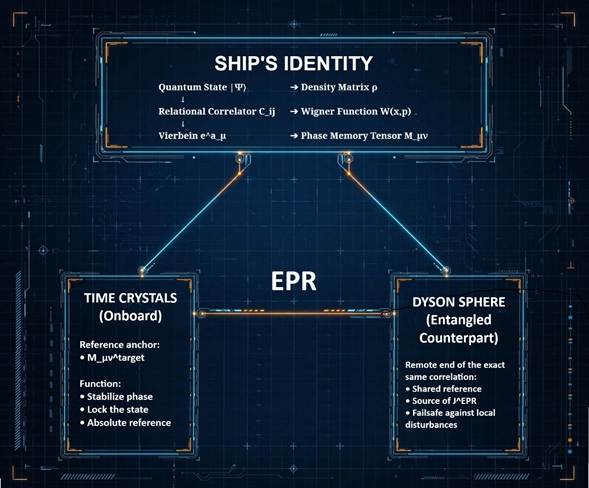
Step 1. The complete quantum state. Before the transition, the ship and crew form a pure state ∣Ψ⟩ in “Hilbert space” (the mathematical space of all possible states). That state holds every particle, every correlation, and every quantum coherence.
Step 2. The density matrix and relational correlator. The state is encoded as ρ=∣Ψ⟩⟨Ψ∣. From there, the relational correlator Cij is extracted. This is the fingerprint of identity: a map of which strings are entangled with which. Two objects made of the exact same atoms but built differently would have totally different Cij maps.
Step 3. The Wigner function. The Wigner-Weyl transform projects the density matrix onto phase space (position and momentum). This is required because the density matrix lives in Hilbert space, lacking μν indices, so it can’t just be jammed into Einstein’s equation.
Step 4. Immersion into curved spacetime. The vierbein eμa translates local Lorentz indices into curved spacetime indices. The final result is the PMT:

What each piece does:
- κ: A coupling constant, incredibly tiny (on the order of the Planck length squared). It makes Mμν negligible in daily life, only letting it dominate during the transition.
- eμa: The vierbein, translating between the local frame and curved spacetime.
- W(x,p): The Wigner function, supplying the quantum content of the state.
- Cab(x): The local relational correlator, supplying the structural identity map of the ship.
- uαuβgαβ: A normalization factor relative to the observer traveling with the ship (u is their four-velocity; the product is a scalar fixing sign and scale).
This tensor is the complete identity of the ship, hard-coded as a field acting directly on spacetime.
3. Quantum Time Crystals: The onboard anchor
The target state of the PMT (Mμνtarget) is physically housed inside the Quantum Time Crystals (Wilczek), an integral part of the Revoredo Engine architecture. Why time crystals?
- Their pattern repeats in time, not just in space. They are absolute quantum reference oscillators.
- In the model, they maintain this periodicity without bleeding energy.
- That periodicity acts as a quantum master clock, locking the phase of the ship’s strings into a highly specific vibration.
In practical terms, the time crystal locks the target state into a stable configuration. It is the reference anchor of identity.
4. The entangled counterpart in the Dyson Sphere
Relying on a single onboard anchor is too risky: if the time crystal glitched during transit, the crew’s identity would be erased. Therefore, the model includes an entangled counterpart located safely at the Dyson Sphere.
Clarification on the “copy.” The ship’s quantum state is never cloned. What is logged is the pattern of correlations (the target PMT), and the counterpart at the Sphere isn’t an independent backup drive; it’s simply the other end of the exact same entanglement. It is a single relational structure being viewed from two places at once.
Thanks to ER=EPR (Principle 17), the particles inside the onboard time crystals are massively entangled with equivalent particles back at the Sphere. No signal is beamed through space: they simply share correlations. If the ship experiences a quantum disturbance, these shared correlations serve as the reference point to measure against and actively repair the deviations. That is the JμνEPR term in the evolution equation. That correlations alone are enough to define identity is a core postulate of the model.
5. The Evolution Equation: Why the PMT is dynamic
A static PMT would degrade rapidly. During hyperspace transit, the ambient tachyonic field constantly batters the strings’ quantum states. Therefore, the PMT requires an evolution equation:

Here, σ is the proper parameter of hyperspace, HCY is the Calabi-Yau Hamiltonian, and γ is the restoration rate. Each term has a specific job:
- First term (unitary evolution): The natural mathematical evolution of the tensor governed by the local geometry of hyperspace.
- Second term (active restoration): If the tensor deviates from its target state, this term forces it back. It’s built like a Lindblad equation but inverted: it restores coherence instead of destroying it. The rate γ must exceed the tachyonic disturbance, which the Time Crystals guarantee.
- Third term (entangled reference): The correlation current linking back to the Dyson Sphere, filtered through local hyperspace geometry. It provides the shared reference for the target state.
6. The Conservation Law: ∇μMμν=0
To play nice with the Revoredo field equation, the PMT has to obey the exact same rule that the energy-momentum tensor obeys in General Relativity: zero covariant divergence. This is the formal, math-heavy way of stating that whatever enters hyperspace must be exactly what exits. If this law were broken, the ship would emerge with a different identity, or not emerge at all.
7. The Fidelity Condition:

Right before hitting the brakes to reconvert, the system checks if the PMT is within a safe, critical threshold of fidelity. If it isn’t, reconversion aborts. Think of it as a quantum “checksum” before restoring a backup. This condition is one of the three required in Phase 4, alongside PT symmetry and proper positioning.
8. Visual Summary of Storage
9. The Philosophical Answer
So, where exactly is the PMT encoded? The deep answer is: in the entanglement web connecting the ship’s strings to the Dyson Sphere’s strings.
It doesn’t live in a “place.” It lives in a relationship. The PMT isn’t a copy of data; it’s the relational structure that literally is the identity, kept alive across a phase transition via a massive network of non-local correlations.
In plain English: the PMT isn’t saved on a hard drive. It’s saved in the relationship between the ship and its home star, and that relationship is what ensures the ship remains the exact same ship after the journey.
ONE-SENTENCE SUMMARY
The ship doesn’t accelerate to break the light barrier; it alters its material nature from baryonic to tachyonic so the barrier ceases to exist, cruises through hyperspace as a closed string, and inverts the process upon arrival, with the Phase Memory Tensor preserving its identity every step of the way.
WHICH PRINCIPLES ARE USED IN EACH PHASE?
| Phase | Active Principles |
| Preparation | 1, 5, 7, 11, 12 |
| Activation | 10, 11, 12, 13, 14, 15, 16, 17, 24, 25, 27, 28 |
| Transition | 2, 4, 5, 6, 7, 9, 13, 29 |
| Cruise | 8, 9, 11, 17, 18, 19, 20, 21, 22, 23, 31, 32 |
| Arrival | 11, 12, 22, 23 |
| Return | 1, 3, 26, 27 |
| Context Only | 30 |
CONCLUSION
The Revoredo Mechanism does not claim to be a proven reality, nor could it be today. The vast majority of its components are drawn from established physics or highly respected, actively researched theories. The assembly of these parts, along with a few specific postulates, is speculative—neither proven nor ruled out. These postulates include harvesting zero-point energy, non-local energy compensation via a Dyson Sphere, loop closure via torsion fields, inhibited condensation held by the engine (RIC), and PMT restoration. These require a Type II-III civilization and engineering that, if even possible, is millennia away.
It is speculative theoretical physics, not science fiction: every step is formulated with explicit mathematics that can be debated and, eventually, tested.
VISUAL ANNEX: ANATOMY OF A TACHYON JUMP
Warning: What you are about to read is an exercise in applied imagination. The mathematics of the Revoredo Model are theoretical physics; the machine we describe here is the science fiction engineering that a Type II or III civilization might construct to make those mathematics a reality.
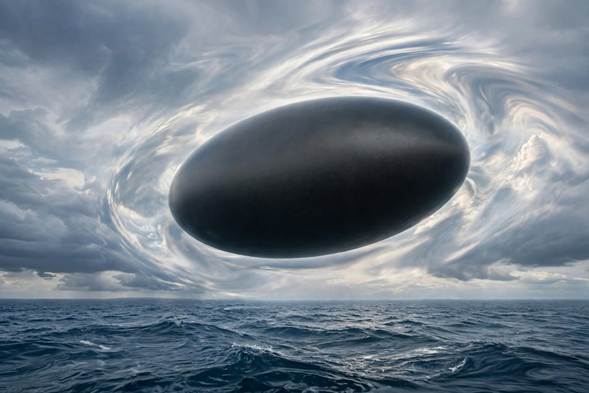
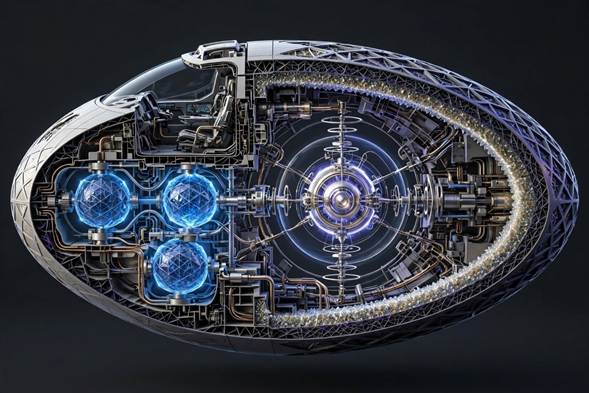
1. The Look: The Perfect “Tic-Tac”
Forget rockets, wings, and fiery exhaust nozzles. In hyperspace, there is no air friction, and you don’t need to blast gas backward to propel yourself forward. The Revoredo ship is shaped like a perfect ellipsoid—a smooth, seamless oval (strikingly similar to the famous “Tic-Tac” UFO sightings). It has no windows; looking directly into hyperspace without a neural interface would shatter a human mind, as three-dimensional mathematics simply do not apply there.
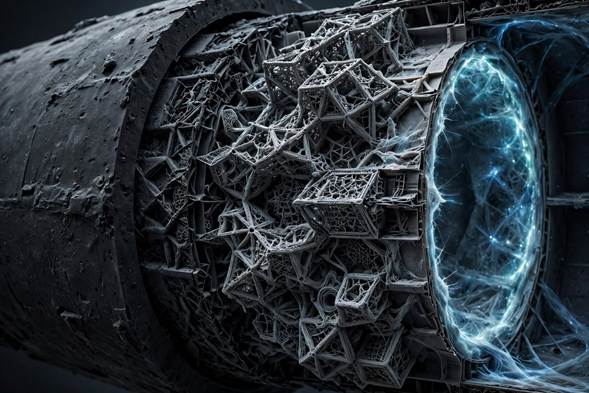
2. Chassis and Skin: Calabi-Yau Metamaterials
The ship isn’t built from steel or titanium. Its outer hull is a solid block of Graphene Metamaterials. To the naked eye, it looks like liquid metal, matte graphite in color, and cold to the touch.
But at a microscopic level, this material is precisely sculpted to mimic the geometry of Calabi-Yau spaces. The hull of the ship is literally the “guitar pick” that will force the strings of the universe to play a different note. The entire interior is lined with Topological Majorana Fermion Condensates—an absolute quantum insulator that protects the crew from being vaporized when the engine hits Planck-scale energy.

3. The Heart of the Engine: The Casimir Chamber
Sitting in the exact center of the ship isn’t a nuclear reactor, but a sphere floating in an electromagnetic vacuum. Inside this sphere are millions of fractal, nanoscale plates.
- Ignition: When the pilot gives the order, these plates snap together to microscopic distances. They begin to “squeeze” the vacuum using a macroscopic Casimir effect.
- The Sound: There are no explosions. You only hear a deep, sub-bass hum vibrating in your bones, followed by absolute silence. The ship is drinking zero-point energy (ZPE). Millions of light-years away, at the Dyson Sphere, a tiny patch of the star dims ever so slightly: the universe’s energy bill has just been paid.
4. Time Crystals: The Identity Anchor
In a heavily shielded vault beneath the cockpit, three tiny spheres of blue light float in mid-air. These aren’t hard crystals like diamonds; they are Bose-Einstein Condensates (clouds of ultra-cold atoms) pulsing to an eternal rhythm. They are the Time Crystals.
At the moment of ignition, these crystals “freeze” and lock in the Phase Memory Tensor (PMT). They hold the exact digital fingerprint of every single molecule of the ship and every memory of the crew. In that precise instant, they silently and instantly “hook” into the Dyson Sphere via entanglement (ER=EPR). The invisible umbilical cord is secure.

THE JUMP SEQUENCE: WHAT THE CREW AND OBSERVERS SEE
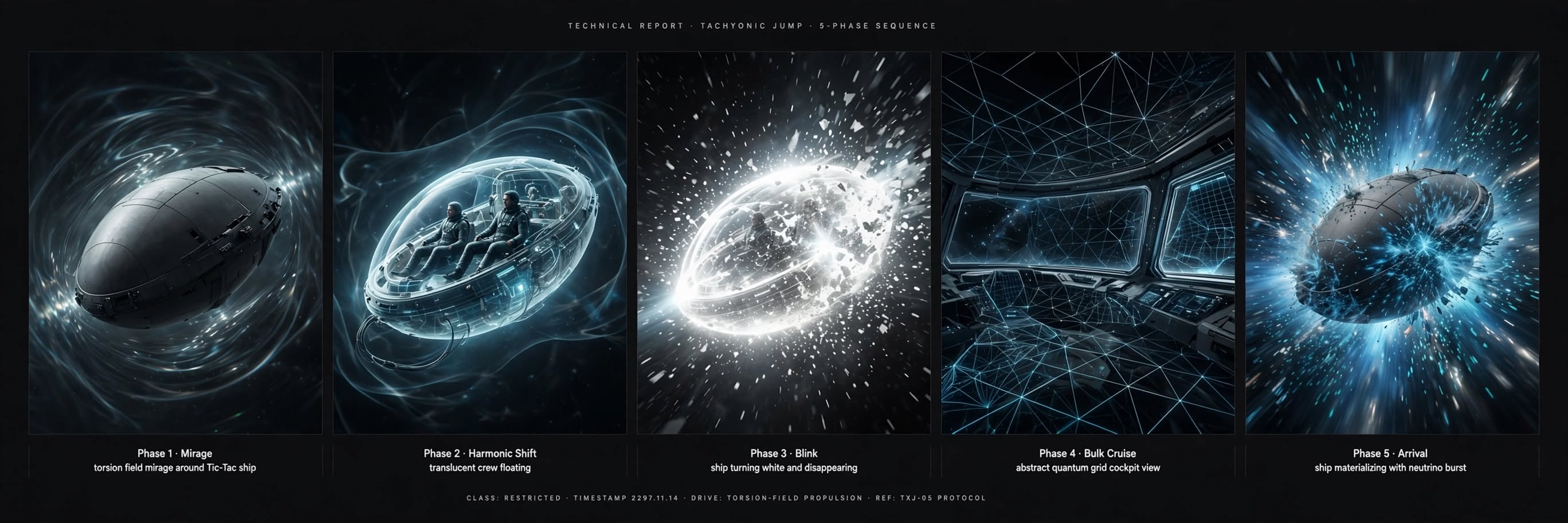
PHASE 1: The Mirage (Activation)
If you were standing outside watching the ship, you wouldn’t see it accelerate and streak into the sky. Instead, the graphite hull begins emitting a torsion field. The air around the ship bends and ripples like a hot highway in summer—a violent mirage caused by artificial gravity.
PHASE 2: The Harmonic Shift (The Unanchoring)
Inside the engine chamber, a battery of ultra-frequency gamma-ray lasers slams into the metamaterial. This triggers a vibration that ripples through the entire ship.
For the crew, gravity vanishes instantly. Their bodies begin to glow with a soft, translucent light. The microscopic strings making up their atoms are shifting from the Dirichlet condition (anchored) to Neumann (free). The mass of their bodies is turning imaginary. It doesn’t hurt, and there’s no feeling of acceleration; in fact, it feels like an infinitely smooth free-fall.

PHASE 3: The Blink (The Jump)
To the outside observer, the ship suddenly flashes a blinding white, emits a silent pulse of light (remnant Hawking radiation), and simply vanishes. No sonic boom, no trail. It has ceased to exist in our 3D universe. It has crossed the inflection point.
PHASE 4: The Cruise (In the Bulk)
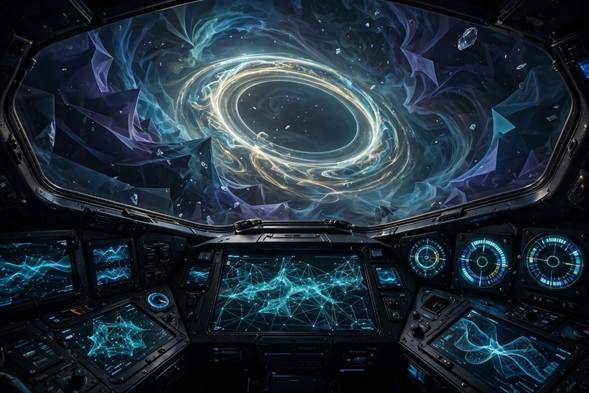
Inside the ship, the tactical screens don’t show stars. They show a grid of abstract data: it’s the quantum GPS reading the complexity levels shared with the Dyson Sphere. Time stops passing. What might take months to cross a galaxy in the outside universe lasts no longer than a blink for the crew. There is no inertia. They are a “ring” of tachyonic matter closed upon itself, gliding through a higher-dimensional void.
PHASE 5: The Arrival (The Reconversion)
The system detects the exact correct coordinates. The engine slams on the quantum “brakes.” Suddenly, in the empty space of the destination star system, a gargantuan visual distortion erupts. A massive shockwave of heat and neutrinos sweeps through the surrounding void. In the dead center of that blast, the ship “precipitates” back into existence, like flash-freezing ice in super-cooled water.
The strings snap open and violently grip 3D reality again. The Phase Memory Tensor (PMT) unpacks: the bodies, the firing neurons, the hull, and the air inside the ship all instantly regain their solid, positive mass.
The sub-bass hum of the engine dies down. The screens return to showing real stars. The intergalactic journey is complete, and aboard the ship, the clock has barely ticked forward a single second.

This guide gives you the concept. The full physics, including the complete mathematical development of the Revoredo Model, is in my book, Beyond the Veil: Uncovering the Truth About UFOs.


Leave a Reply