For centuries, theology has told us a beautiful but incomplete story: that humans were the first intelligent creation, the pinnacle of perfection, alone in the universe with the Creator. Over time, we’ve developed what we might call “cosmic arrogance.”
But if we strip away later dogma and examine the literal translations of humanity’s oldest texts, a different history emerges. First: Earth was not the Creator’s first endeavor. Second: the idea that the ancient world was purely polytheistic is a massive misunderstanding. Ancient cultures consistently recognized a single Supreme Source—whether called Yahweh, Anu, Ticci Viracocha, or Tupā. Operating directly under that Creator, however, were intermediate beings: immensely older, highly developed, physical entities who visited every corner of the Earth.
The Same Phenomenon, Different Names: The Global Evidence
How is it possible that civilizations separated by vast oceans and thousands of years described the exact same beings descending from the sky? The archaeological and textual evidence leaves very little room for doubt: these weren’t isolated myths. They were the same strikingly similar crews of physical visitors interacting with different human cultures.
As early humans tried to process the arrival of tangible, highly technological beings, they simply named them according to their own local languages. Look at the staggering global convergence in the original texts:
Ancient Hebrews and Christians (Angels / Mal’akh): Later theology tried to turn them into “pure, invisible spirits,” but the Bible says otherwise. In Genesis 18 and 19, the angels who visit Abraham and Lot are so remarkably physical that they eat meat, have their dusty feet washed, and sleep in beds. They were mistaken for ordinary foreign travelers. They possessed the technology or power to blind a mob, but they were biological, tangible beings.
Sumerians and Akkadians (Sukkal / Apkallu / Iggigi): Cuneiform tablets do not describe ghosts; they describe biological beings stepping out of ships or the ocean. They wore hermetic suits—often described as fish- or bird-like to help them breathe—wore technological devices on their wrists, and acted as the “ministers” and heavenly workers who taught mankind the sciences.
Tiahuanaco and the Inca Empire (Viracochas): Spanish chronicles recorded that the helpers of the god Viracocha were not phantoms. They were flesh-and-blood men with fair skin, beards, and tunics, who walked through the Andes healing the sick using devices—often described as “staffs”—capable of altering solid stone. When they left, they departed by walking across the sea.
Greeks (Daimones / Angeloi): These weren’t mystical fogs. They descended from a physical base (Mount Olympus), used real technological gear (helmets of invisibility, flying sandals), and were so biologically compatible with humanity that they produced hybrid offspring (demigods).
Aztecs (Ehecatotontli): The helpers of Quetzalcoatl—who himself was described as a physical, bearded man—arrived from the sky or sea in vessels. They controlled the weather using what translations describe as devices that manipulated the winds.
Mapuche, Guarani, and Maori: From the Angatupyry guardians of the South American jungle, to the Wangulen (Star Women) of Chile, to the Turehu of New Zealand. All these traditions insist these beings were tangible, possessed superior genetic knowledge, taught basic sciences, and eventually returned to the heights.
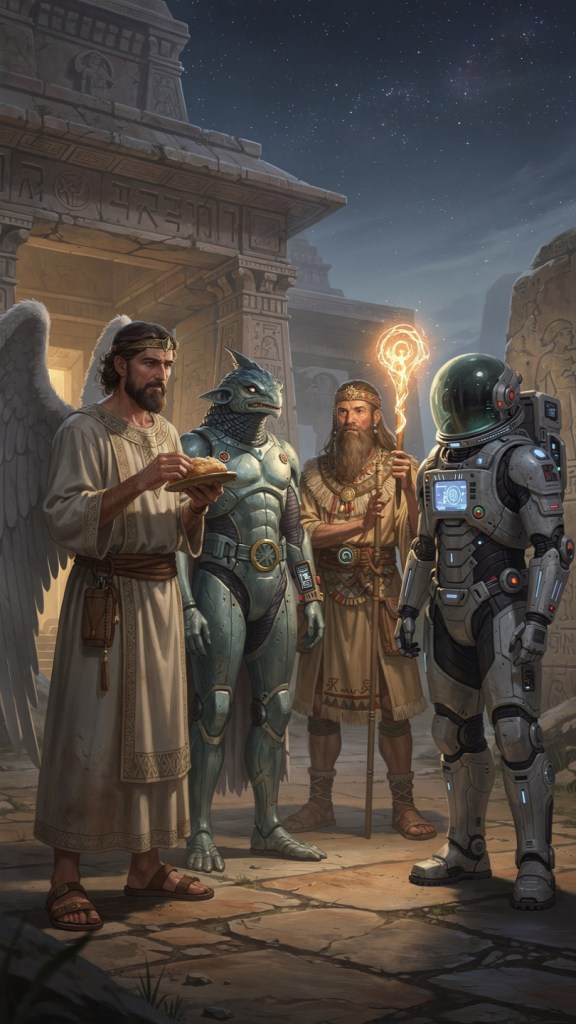
These weren’t “dozens of different gods.” It was the same Creator operating through His celestial intermediaries. They were beings of flesh, bone, and science—beings who had mastered interplanetary travel.
The Modern Exegetical Error: Perfect on Earth, Not in the Universe
A common argument is that man is “God’s most perfect creation.” But this is where modern religion misreads its own books. God stated that humans were His crowning achievement on Earth, but He never said we were the only ones in the universe, let alone the first.
The biblical text is actually quite clear on this. In the Book of Job (38:4–7), God rebukes Job by explaining the history of the cosmos. He asks Job where he was when the foundations of the Earth were laid, and reveals that while our planet was just being designed:
“The morning stars sang together, and all the sons of God shouted for joy.”
Let that sink in. While Earth was still a construction site and human beings didn’t even exist yet, other “sons of God” were already watching. These intermediate beings already had hierarchies, technology, and purpose. We were simply the new kids on the cosmic block—a block that had been inhabited for eons.
Archaeology Supports the Concept of the “Watchers”
Our ancestors knew that these intermediaries—known in Sumerian as the Iggigi—were monitoring them from space. Literally, the Akkadian root word Igi translates to “Eye” or “To See,” perfectly aligning with the “Watchers” from the Book of Enoch.
The physical evidence rests at Tell Brak (modern-day Syria). There, at a site dating back to 3700 BCE, archaeologists unearthed the “Eye Temple,” which was filled with thousands of stone figurines featuring massive, wide-open eyes. Our earliest ancestors weren’t sculpting fantasies; they were documenting the reality of constant surveillance from the sky by physical entities.
It’s Time to Keep an Open Mind
The historical, archaeological, and textual evidence is overwhelming. If tomorrow, mainstream science or world governments confirm contact with highly advanced extraterrestrial intelligences, it shouldn’t trigger a crisis of faith.
Discovering cosmic intelligences older than our own doesn’t destroy the concept of God; it confirms and amplifies it. It proves that His creation is infinitely vaster than a single isolated rock in the Milky Way.
We need to prepare our minds. Understanding that superior life exists out there isn’t science fiction—it’s a return to our original history. If other beings reveal themselves, they won’t be alien monsters; they will be the ones our sacred books already documented millennia ago. They will be the Apkallu, the Viracochas, the true Angels of Genesis.
We were created, yes. We have a divine purpose, yes. But the official narrative got one crucial detail wrong: humanity has never been alone.
Note: Skeptics will argue that these are mere myths, but that dismisses the cross-cultural consistency and the physical nature of the descriptions—unlike later spiritualized reinterpretations. When every major civilization, isolated by oceans and centuries, describes bearded men in flying vessels with healing rods, we are no longer in the realm of coincidence.


Leave a Reply