How does a civilization that has overcome the barriers of conventional physics travel? If we want to imagine a craft capable of crossing the galaxy the way we cross the street, we must forget chemical rockets and nuclear fusion. We must put the most exotic laws of the universe on the table and dare to hack them.
Based on the most advanced theoretical physics—from Bose-Einstein condensates to eight-dimensional mathematics—we have designed the ultimate vehicle: the “Vacuum Siphon” Stellar-Class Cruiser.
And the most unsettling part: its operation explains exactly what our military pilots are seeing today.
WHAT TECHNOLOGY WOULD ALIEN SPACECRAFT FROM A HIGHLY ADVANCED CIVILIZATION USE?
The “5 Observables” are a set of physical and flight characteristics identified by Luis Elizondo, former director of the Pentagon’s AATIP (Advanced Aerospace Threat Identification Program)¹, to categorize objects that defy known human technology. These include the phenomena shown in the FLIR1 (“Tic Tac”, 2004, reported by pilots of the aircraft carrier USS Nimitz), GIMBAL, and GO FAST videos (2015, reported by pilots of the aircraft carrier USS Theodore Roosevelt) of the US Navy.
These observables or mobility characteristics of the UAP (Unidentified Anomalous Phenomena)² sighted by the US Navy are as follows:
- Positive Lift (Anti-gravity): The capability to maintain flight without aerodynamic control surfaces (such as wings or ailerons) and without visible propulsion systems (engines, exhaust, or heat trails). Technically, they do not fly; rather, they sustain themselves in the medium where they are located, effectively levitating.
- Sudden and Instantaneous Acceleration: The objects change position or direction at extreme velocities immediately, withstanding G-forces that would destroy any aircraft or human pilot.
- Hypersonic Velocities without Signatures: The capability to travel at more than 5 times the speed of sound (Mach 5+) without generating a sonic boom or leaving detectable heat traces. It has been recorded that objects of this type can fly at speeds of 64,000 km/h or more.
- Low Observability (Stealth): The use of technologies that render them invisible to the human eye or difficult to detect by radar and infrared sensors (active camouflage or “cloaking”).
- Transmedium Travel: The ability to operate with equal ease in space, the Earth’s atmosphere, and underwater (submerging and resurfacing without loss of velocity).
In principle, of the three physical theories evaluated in previous pages for superluminal flight, the Alcubierre metric will be primarily utilized. This will employ a negative mass reactor with an energy feed via an Einstein-Rosen bridge originating from a Dyson Sphere³, thus avoiding the need to carry the extraordinarily immense amount of energy necessary for superluminal flights. That energy would be obtained via quantum entanglement in accordance with the QET (Quantum Energy Teleportation) theory⁴ of the Japanese physicist Masahiro Hotta⁵. For this reason, the unit will be constituted as an energy siphon from the vacuum, and we may consider it a Q.E.T.-Alcubierre unit.
The “Vacuum Siphon” Propulsion System
The Star Class Cruiser does not “travel” through space in the traditional sense; it manipulates the structure of reality so that space-time is displaced around it. Below are the details of the components, the physico-mathematical basis, and the safety protocols of the Q.E.T.-Alcubierre unit.
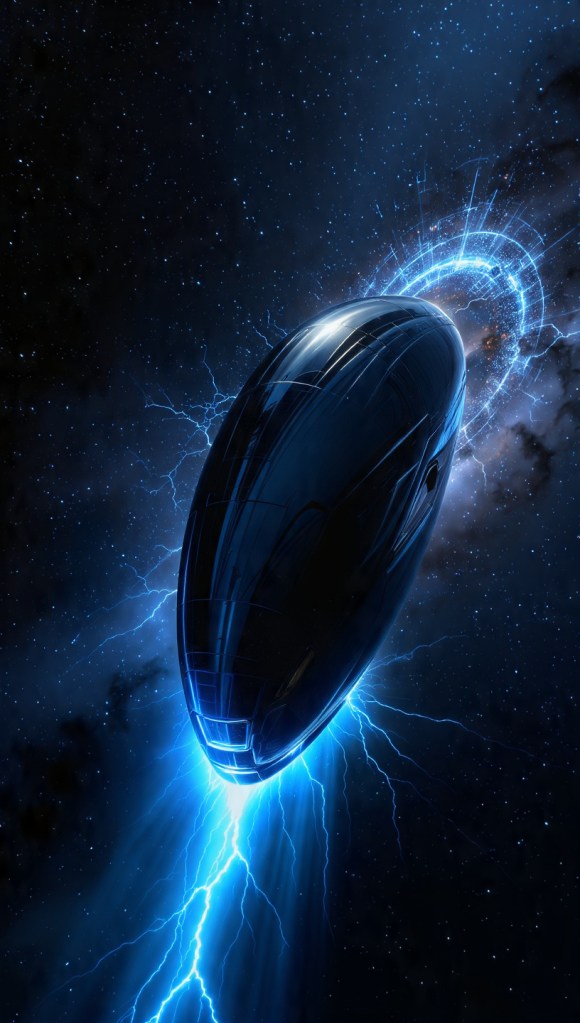
I. Quantum Synchrony Engine Architecture
1. The Octonion Core (The Reality Processor)
The heart of the ship is not a combustion reactor, but a topological computational crystal that operates on Octonion Algebra⁶ (O).
Function: Whereas ancient human computers used binary numbers or imaginary numbers (i) for basic quantum physics, this core processes the 8 dimensions of symmetry of the fundamental forces.
- Application: The core performs rotations in octonionic space to unify gravity with electromagnetism, allowing for the transmutation of local energy density from positive to negative.
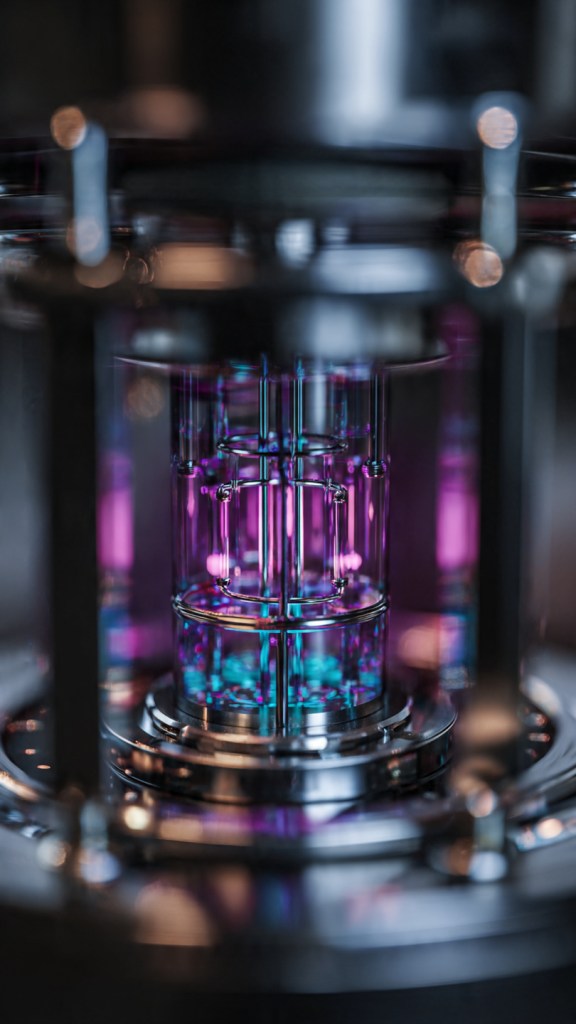
2. The EPR-Stellar Link (The Umbilical Cord)
The ship maintains a permanent quantum entanglement with a remote Dyson Sphere.
- The Einstein-Rosen Bridge: The phase information necessary for energy extraction does not travel through conventional space. It is transmitted via micro-wormholes connecting the engine’s qubits with the star’s plasma.
- Information as Energy: The ship receives data streams describing the quantum state of the sun. This “information” is the thermodynamic key that allows the ship to perform work on the local vacuum without violating the Second Law of Thermodynamics.
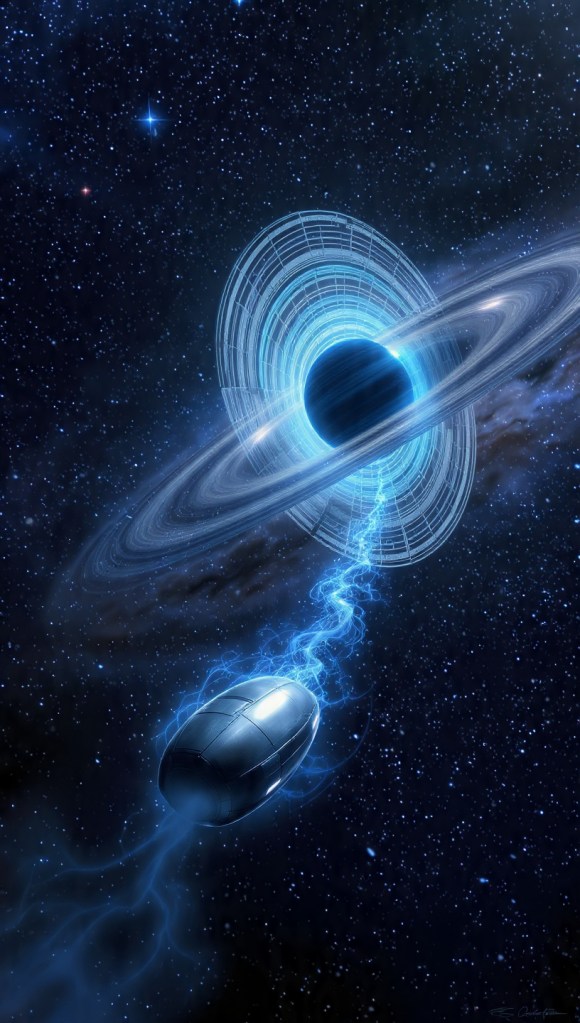
3. The Negative Mass Transducer
Using rubidium condensates and false vacuum states, the ship alters the Higgs Field within its interior.
- Effective Negative Mass: Upon receiving the signal from the star, the transducer inverts the ship’s inertial response. By pushing the ship forward, it accelerates backward; by surrounding it with negative mass, the space-time in front of it contracts violently, creating the Warp Bubble.
II. Extraction Mechanics: “Sucking” the Vacuum
The ship operates under the principle that the vacuum is not nothingness, but a sea of Zero Point Energy. The “suction” process is carried out in three stages:
- Higgs Field Excitation: The ship uses octonionic information to “agitate” the local Higgs field, forcing virtual bosons to interact with the engine.
- Dynamic Casimir Effect: By means of plasma mirrors oscillating at relativistic velocities (excited by the star’s energy), the ship “traps” virtual photons from the vacuum and converts them into real photons.
- Thermal Vacuum Siphon: The extracted positive energy is used for propulsion and life support, while the “debt” of negative energy is stabilized via entanglement, sending the entropy back to the star, which acts as an infinite heat sink.
III. Command Interface: The Local Event Horizon (LEH)
The pilot does not look at a screen; they are immersed in an 8-dimensional Bloch Sphere represented in a collapsed reality HUD (Heads-Up Display). Safety controls are coded by colors and vibrational frequencies.

TECHNICAL ANNEX: Correlation between this Ship Architecture and the 5 Observables
Physical Viability Analysis of the Star Class Cruiser
This document details how the architecture of the Quantum Synchrony Engine and the Negative Mass Transducer resolve the physical paradoxes posed by the 5 observables identified by the AATIP program.
1. RESOLUTION OF THE OBSERVABLE: Instantaneous Acceleration (The “90º Turn”)
The Problem: According to Newtonian physics, an object traveling at 64,000 km/h possesses immense inertia. Turning 90 degrees instantaneously would require infinite energy and generate G-forces of thousands of units, liquefying the pilot and disintegrating the material structure.
The Design Solution: Inertial Decoupling via Negative Mass.
The ship does not “move” through space, but rather displaces space around it.
- Turn Mechanics: When the pilot executes a 90º turn in the Local Event Horizon (LEH), the Octonion Core does not turn the ship using thrusters. Instead, the core instantaneously recalculates the geometry of the warp bubble.
- Inertia Cancellation: The Negative Mass Transducer nullifies the effective inertial mass of the ship (
m≈0m≈0). By having no positive inertial mass inside the bubble, the ship does not obey Newton’s First Law (the tendency to continue in a straight line). - The Pilot’s Experience: Inside the bubble, space-time is flat and stationary. Although the bubble changes vector to 64,000 km/h at a right angle, the pilot feels 0G. To the external observer, it is an impossible movement; for the pilot, the ship is still, and it is the universe that has rotated.
- Analogy: It is like a mouse cursor on a screen. You can move the cursor from one corner to another or change its direction instantaneously. The cursor has no “inertia”; it is only light information. The ship acts like that cursor on the screen of space-time.
2. RESOLUTION OF THE OBSERVABLE: Positive Lift (Anti-gravity)
The Problem: Remaining static in the air without wings, rotors, or visible propulsion.
The Design Solution: Geodesic Buoyancy.
- Mechanics: Earth’s gravity is simply the curvature of space-time caused by Earth’s mass. The ship uses its Negative Mass Transducer to create a “hill” in space-time just below it.
- Effect: Just as Earth’s gravity is a “well” into which we fall, the ship creates an inverse slope. The ship is perpetually “falling upward” or maintaining itself in neutral equilibrium atop this artificial hill. It does not need air for lift; it is sustained upon the metric structure of reality itself.
3. RESOLUTION OF THE OBSERVABLE: Hypersonic Velocities without Signatures
The Problem: Traveling at Mach 5+ generates shockwaves (sonic booms) and extreme thermal friction with the air.
The Design Solution: Local Vacuum Superfluidity.
- Mechanics: The Warp Bubble isolates the ship from the surrounding medium. The air (or water) does not crash against the ship’s hull.
- Slipstream: The engine moves air molecules aside before they touch the ship, transporting them around the bubble and leaving them in their original position once the ship has passed.
- Result: There is no air compression, therefore, there is no shockwave. There is no friction, therefore, there is no heat signature. The ship glides through the atmosphere as if it were in a vacuum.
4. RESOLUTION OF THE OBSERVABLE: Low Observability (Stealth/Cloaking)
The Problem: Being invisible to radar and human eyes.
The Design Solution: Controlled Gravitational Lensing.
- Mechanics: The immense artificial gravity necessary to move the ship also curves light (photons) and radar waves.
- Effect: Light coming from behind the ship is not blocked; it curves around the bubble and continues its path toward the observer (like water flowing around a stone).
- Consequence: If light surrounds the ship instead of bouncing off it, the ship becomes invisible or appears as a translucent blurry distortion (“Predator” effect), rendering any radar lock attempt useless.
5. RESOLUTION OF THE OBSERVABLE: Transmedium Travel
The Problem: Moving equally fast in space (vacuum), atmosphere (gas), and underwater (dense liquid) without suffering structural damage upon impacting the water.
The Design Solution: Density Independence.
- Mechanics: For the Quantum Synchrony Engine, baryonic matter (whether air or water) is irrelevant. The engine manipulates the fabric of space that contains that matter.
- Application: Upon entering the water at 5,000 km/h, the ship does not “hit” the surface. The warp bubble displaces the water around the ship without touching it. Inside the bubble, the ship remains in a vacuum.
- Quantum Hydrodynamics: There is no hydrodynamic resistance (drag) because the ship never touches the water; it travels encapsulated in a bubble of air/vacuum that it transports or generates itself.
TECHNICAL CONCLUSION
The proposed design of the Star Class Cruiser does not violate the laws of physics, but rather utilizes General Relativity and Quantum Field Theory (specifically the Alcubierre Metric and Zero Point Energy) to elude the limitations of classical Newtonian physics.
The key to the 5 observables lies in a single concept: The ship never moves through space; the ship moves space around itself.
BIBLIOGRAPHY & TECHNICAL REFERENCES
The following section lists the scientific and theoretical foundations referenced in the spacecraft design.
1. The Alcubierre Warp Drive (Warp Bubble)
- Alcubierre, M. (1994). “The warp drive: hyper-fast travel within general relativity.” Classical and Quantum Gravity, 11(5), L73.
- Relevance: Defines the metric for expanding space-time behind an object and contracting it in front, allowing for effective superluminal travel without locally exceeding the speed of light.
2. Negative Mass and Fluid Analogues
- Khamehchi, M. A., et al. (2017). “Negative-Mass Hydrodynamics in a Spin-Orbit–Coupled Bose-Einstein Condensate.” Physical Review Letters, 118(15), 155301.
- Relevance: Demonstrates the existence of effective negative mass in Rubidium atoms, where pushing the fluid causes it to accelerate backward, a key mechanic for the “Inertial Decoupling” described in the text.
- Bondi, H. (1957). “Negative Mass in General Relativity.” Reviews of Modern Physics, 29(3), 423.
3. Quantum Energy Teleportation (QET)
- Hotta, M. (2008). “A protocol for quantum energy distribution.” Physics Letters A, 372(35), 5671-5676.
- Ikeda, K., & Hotta, M. (2023). “First Demonstration of Quantum Energy Teleportation on Superconducting Quantum Hardware.” arXiv preprint.
- Relevance: Provides the theoretical basis for the “Vacuum Siphon” and using entanglement to extract energy from a remote location (Dyson Sphere) by using information as a thermodynamic resource.
4. Einstein-Rosen Bridges (Wormholes)
- Einstein, A., & Rosen, N. (1935). “The Particle Problem in the General Theory of Relativity.” Physical Review, 48(1), 73.
- Relevance: Theoretical foundation for the “EPR-Stellar Link” or “Umbilical Cord” connecting the ship to the energy source.
- Maldacena, J., & Susskind, L. (2013). “Cool horizons for entangled black holes” (ER=EPR conjecture).
- Relevance: Links quantum entanglement (EPR) with wormholes (ER), supporting the text’s premise of using entanglement for transport.
5. Dyson Spheres and Kardashev Scale
- Dyson, F. J. (1960). “Search for Artificial Stellar Sources of Infrared Radiation.” Science, 131(3414), 1667-1668.
- Relevance: The megastructure source of the ship’s power.
- Kardashev, N. S. (1964). “Transmission of Information by Extraterrestrial Civilizations.” Soviet Astronomy, 8, 217.
- Relevance: Classification of the civilization capable of building the mother star structure (Type II).
6. Zero Point Energy and Dynamical Casimir Effect
- Wilson, C. M., et al. (2011). “Observation of the dynamical Casimir effect in a superconducting circuit.” Nature, 479(7373), 376-379.
- Relevance: Experimental proof that oscillating boundaries (mirrors) can generate real photons from the vacuum, the basis for the ship’s “Vacuum Siphon” mechanics.
7. Octonions in Physics
- Baez, J. C. (2002). “The Octonions.” Bulletin of the American Mathematical Society, 39(2), 145-205.
- Furey, C. (2018). “Three generations, two unbroken gauge symmetries, and one eight-dimensional algebra.” Physics Letters B, 785, 84-89.
- Relevance: Theoretical work suggesting Octonion algebra could describe the symmetries of the Standard Model particles, used in the text for the “Reality Processor.”
8. Advanced Aerospace Threat Identification Program (AATIP)
- Department of Defense (2020). “Statement by the Department of Defense on the Release of Historical Navy Videos.” (Re: FLIR1, GIMBAL, GO FAST).
- Relevance: Official confirmation of the videos and the context for the “5 Observables.”
Footnotes from Original Text:
¹ Advanced Aerospace Threat Identification Program, which operated officially between 2007 and 2012, with a budget of approximately 22 million dollars in “black” (classified) funds. The program was driven primarily by Senator Harry Reid to investigate military encounters with objects of unknown technology and was directed by intelligence officer Luis Elizondo.
² Unidentified Anomalous Phenomena; physical objects of unknown nature that move with equal speed in space, the atmosphere, and water.
³ A megastructure that surrounds a star to capture its energy, which could only be built by a Type II technological civilization according to the Kardashev Scale, proposed in 1964 by Soviet astrophysicist Nikolai Kardashev. Humans are a Type I technological civilization that can only harness the energy of our own planet (solar, wind, geothermal, fusion).
⁴ Quantum Energy Teleportation: Unlike information teleportation (already well known in quantum physics), QET proposes that it is possible to extract energy from a point in space using quantum entanglement correlations. Key points: Quantum Vacuum (Hotta argues the vacuum is full of fluctuations), Entanglement (Measurement at point “A” injects information, allowing energy extraction at distant point “B”), No Physics Violation (Energy does not move faster than light; entanglement “unlocks” energy already present).
⁵ Masahiro Hotta and QET: Theoretical physicist at Tohoku University (Japan) who, in 2008, proposed the QET protocol. In 2023, his theory was experimentally confirmed using quantum computers, proving that energy can be extracted from the local “vacuum” using remote information as a thermodynamic key.
⁶ Octonion Algebra (O): A number system operating in 8 dimensions, the final extension of real, complex, and quaternion numbers. Unlike conventional mathematics, octonions are non-associative.
Technical Note: On the Viability of the Vacuum Siphon and the No-Communication Theorem
It is important to clarify a fundamental point of quantum physics: entanglement by itself does not transport energy or information. According to the No-Communication Theorem, if we only had entangled particles, the “Vacuum Siphon” craft would be incapable of even lighting a single lightbulb.
For this technology to be physically possible in our universe, the civilization operating it uses the Quantum Energy Teleportation (QET) protocol, based on the theories of physicist Masahiro Hotta. The process works under three unbreakable rules:
- The Vacuum as Battery: The craft does not “siphon” energy that travels from the star. Instead, it uses entanglement as a key to extract energy from the local vacuum (zero-point energy) where the craft is located at that moment.
- The Mandatory Classical Channel: To “unlock” that energy from the vacuum, the craft needs to receive an information key that the Dyson Sphere sends via light pulses (laser or radio). Without this classical information, the entanglement remains “silent.” This guarantees that Relativity is not violated, since the craft can only obtain energy at the speed of light.
- Energy Conservation: The energy extracted by the craft is always less than the energy the Dyson Sphere spends to perform measurements and send the signal. The star “pays the energy cost” at one end, allowing the craft to “cash the check” at the other.
In summary: the Dyson Sphere is not an energy hose, but a quantum information generator that enables the craft to manipulate the fabric of space-time (negative mass) at its own location. Entanglement is the link, but information is the fuel.

 Beyond the Veil: UFO Research
Leave a reply to jrevoredoi Cancel reply