Before Sputnik, before the first satellite launch, something was flying in formation above our heads. And now, the math proves it.
What if I told you the “Space Age” didn’t actually begin with the launch of Sputnik? What if I told you that years before humanity put a single bolt into orbit, there were already “things” up there—and the evidence has been hiding in plain sight?
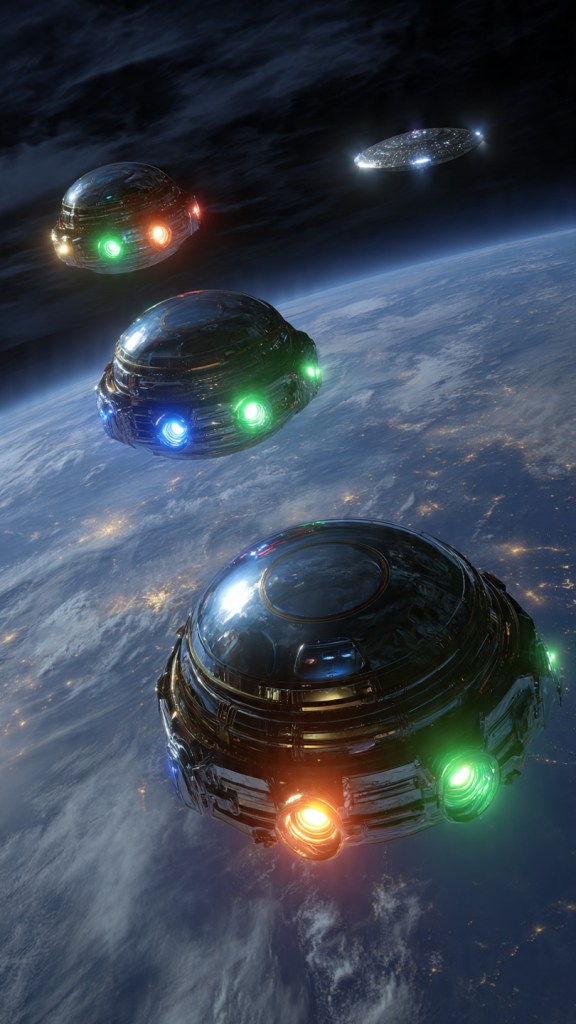
For decades, the UFO phenomenon (now officially dubbed UAP—Unidentified Anomalous Phenomena) has been stuck in the realm of grainy photos and campfire stories. But this year, science dropped a bombshell. We aren’t talking about conspiracy forums; we’re talking about two peer-reviewed scientific studies published in Scientific Reports (Nature) and Publications of the Astronomical Society of the Pacific that analyzed historical photographic plates with crushing mathematical rigor.
What they found is unsettling, fascinating, and statistically undeniable.
The Mystery of the “Transients”
Imagine a photograph of the night sky taken in 1952. In it, you see three bright stars forming a perfect line. In the next photo, taken just minutes later, they’re gone. Vanished.
Astronomers call these “transients.” The VASCO project (Vanishing and Appearing Sources during a Century of Observations) researchers found thousands of them on archival plates from the Palomar Observatory dating back to the 1950s. But these two new studies dug deeper and uncovered patterns that defy natural explanation.
1. The Nuclear Connection: Were We Being Watched?
The first study, led by researchers from Vanderbilt University and Sweden’s Nordita Institute, asked a bold question: Did these lights appear at random?
By cross-referencing the astronomical data with historical records of 124 above-ground nuclear tests conducted by the United States, Soviet Union, and Great Britain between 1949 and 1957, they discovered something spine-chilling: these lights appeared most frequently around the dates of atomic bomb detonations.
The Data: These strange lights were 45% more likely to appear on dates surrounding a nuclear test (within ±1 day). The relative risk ratio was 1.45 with a 95% confidence interval of 1.10–1.90, reaching statistical significance at p = 0.008.
The Coincidence: These lights also appeared more frequently when people on the ground reported mass UFO sightings. In fact, one of the most pristine alignments found in the photos (“Candidate 5”) occurred on July 27, 1952.
Why that date matters: That was the exact night of the famous Washington D.C. UFO Flap, where military radar and pilots tracked unknown objects buzzing the U.S. Capitol during one of the most extensively documented aerial anomalies in history.
Now, a skeptic might say: “It was probably just radiation artifacts or flashes from the bomb tests.” And this is where basic physics tells us “No.”
The Detail That Changes Everything: Long Exposure
Astronomical cameras in the 1950s weren’t like your iPhone. To capture a single image, the shutter had to remain open for 50 minutes.
- If these lights were quick flashes (like lightning or a bomb blast), they wouldn’t show up in a 50-minute exposure—or they would appear as faint, ghostly smears.
- But in the photos, these lights are solid, sharp, and bright—indistinguishable from stars. For that to happen in such a long exposure, the object would have to remain visible for a sustained period. It wasn’t a spark; it was something that lingered long enough to burn its image onto the plate.
2. The Earth Shadow Test: The Smoking Gun
Here’s where the science becomes absolutely brutal.
The second study applied the ultimate test to determine whether we’re looking at flaws in the photographic film (like dust or chemical spots) or actual physical objects in space: the Earth shadow test.
Here’s the logic: If these lights were just dust on the lens or chemical defects, they would appear anywhere in the photo, regardless of where the Sun is. Dust doesn’t care about orbital mechanics.
But if they’re solid objects in orbit (like satellites), we can only see them if they reflect sunlight. If they pass into Earth’s shadow (the cone of darkness our planet casts into space), they should vanish.
What did they find?
The lights systematically avoid Earth’s shadow. At an altitude of 42,164 km (geosynchronous orbit), there is a massive deficit of these transients in the shadowed regions.
How sure are we? This is where it gets extraordinary.
The statistical certainty is measured in sigmas (σ). In physics:
- 3 Sigma: Strong evidence
- 5 Sigma: The gold standard (used to confirm the discovery of the Higgs Boson)—means there’s a 1 in 3.5 million chance it’s a fluke
- This study found a certainty of 22 Sigma
To put that in perspective: Imagine flipping a coin. If you get heads 5 times in a row, you’re suspicious. If you get heads 1,000 times in a row, you know the coin is rigged. 22 Sigma is like flipping that coin and getting the same result thousands upon thousands of times in a row.
Mathematically, it is virtually impossible for this to be a coincidence. The deficit of transients in Earth’s shadow proves these objects require sunlight to be visible—they are reflecting the Sun, not emitting their own light, and not simply photographic defects.
3. The Geometric Alignments: Beyond Coincidence
But it gets even stranger.
Some of these transients don’t just appear randomly scattered across the sky. In multiple cases, they appear aligned in nearly perfect straight lines—with statistical significance ranging from 3 to 4 sigma for the most compelling cases.
The researchers identified 83 candidate alignments, with the top 5 showing alignments of 3-5 transient objects arranged within extremely narrow bands (1-15 arcseconds wide) spanning several arcminutes of sky.
Why does this matter?
If you have random plate defects or dust specks, the probability of them accidentally forming perfect lines is astronomically low. But if you have reflective objects tumbling in coordinated orbits, producing brief glints of sunlight as they rotate, you would expect exactly this pattern.
The most statistically significant case shows five objects aligned within a 10-arcsecond band, with a probability of occurring by chance of approximately 0.0001 (roughly 3.9σ significance).
The Verdict: The Data Has Spoken
We have multiple converging lines of evidence:
- Temporal correlation with nuclear tests: 45% increase in transient detections (p = 0.008)
- Temporal correlation with UAP sightings: 8.5% increase per additional UAP report (p < 0.001)
- Earth shadow deficit: 22-sigma statistical certainty that these objects avoid Earth’s shadow
- Geometric alignments: Multiple cases with 3-4 sigma significance
Let’s examine the possible explanations:
The Natural Option: There is an unknown atmospheric or astrophysical phenomenon that: – Creates solid, star-like lights (not flashes) – Lasts long enough to appear in 50-minute exposures – Aligns in geometric formations – Systematically avoids Earth’s shadow – Correlates with nuclear weapons testing – Correlates with independent UAP sightings
This explanation requires us to invent multiple new physics simultaneously. It’s not impossible, but it’s extraordinarily improbable.
The Artificial Option: There were physical, solid, reflective objects orbiting Earth in the early 1950s, flying in formation, reflecting sunlight, and showing increased activity during nuclear weapons tests.
The convergence of three independent statistical analyses—each peer-reviewed, each pointing in the same direction—makes the artificial explanation the most parsimonious. The data doesn’t require elaborate new physics. It requires accepting what the mathematics is telling us.
Since humans didn’t have space technology until October 4, 1957 (Sputnik launch), this leads us to a conclusion that would have been dismissed as pseudoscience just years ago: Either someone had secret orbital technology years ahead of its time… or it wasn’t human technology at all.
What the Scientists Found
These aren’t fringe researchers. The lead authors include:
- Dr. Beatriz Villarroel (Nordita, KTH Royal Institute of Technology and Stockholm University)
- Dr. Stephen Bruehl (Vanderbilt University Medical Center)
- Dr. Enrique Solano (Spanish Virtual Observatory)
The studies were peer-reviewed and published in top-tier scientific journals. The methodology is sound. The statistics are overwhelming. The data has been made available for independent verification.
This is not speculation. This is the current frontier of our knowledge, based on the best available evidence analyzed with the most rigorous statistical tools we have.
The convergence of independent statistical tests—nuclear correlation, UAP correlation, shadow avoidance, and geometric alignment—points toward a single, coherent explanation: reflective objects in geosynchronous orbit before the satellite era.
The science has spoken. The data is there, etched onto glass plates from 70 years ago. Three independent statistical analyses, all peer-reviewed, all pointing in the same direction with crushing mathematical certainty.
The question isn’t if there was something up there. The data answers that question with 22-sigma certainty.
The question is: Whose were they?
References
- Bruehl, S., & Villarroel, B. (2025). Transients in the Palomar Observatory Sky Survey (POSS-I) may be associated with nuclear testing and reports of unidentified anomalous phenomena. Scientific Reports, 15, 34125. https://doi.org/10.1038/s41598-025-21620-3
- Villarroel, B., Solano, E., Guergouri, H., et al. (2025). Aligned, Multiple-transient Events in the First Palomar Sky Survey. Publications of the Astronomical Society of the Pacific, 137, 104504. https://doi.org/10.1088/1538-3873/ae0afe
Love mysteries solved by hard science? Subscribe for more deep dives where we separate the fiction from the facts.ard science? Subscribe for more deep dives where we separate the fiction from the facts.

 Beyond the Veil: UFO Research
Leave a comment