The Polanco Case
Bariloche, Argentina. July 31, 1995.
The winter night hangs like black velvet over Teniente Luis Candelaria Airport. Inside the control tower, routine is broken only by radio static. Above, Aerolíneas Argentinas Flight AR-674, a Boeing 727-200, begins its final approach.
On board are 140 passengers, including—by a twist of fate—a group of nuclear physicists attending a conference. Scientific minds about to witness the impossible. In the cockpit, Captain Jorge Polanco, a pilot with decades of experience, executes the procedure with the practiced precision of someone who has done it a thousand times before.
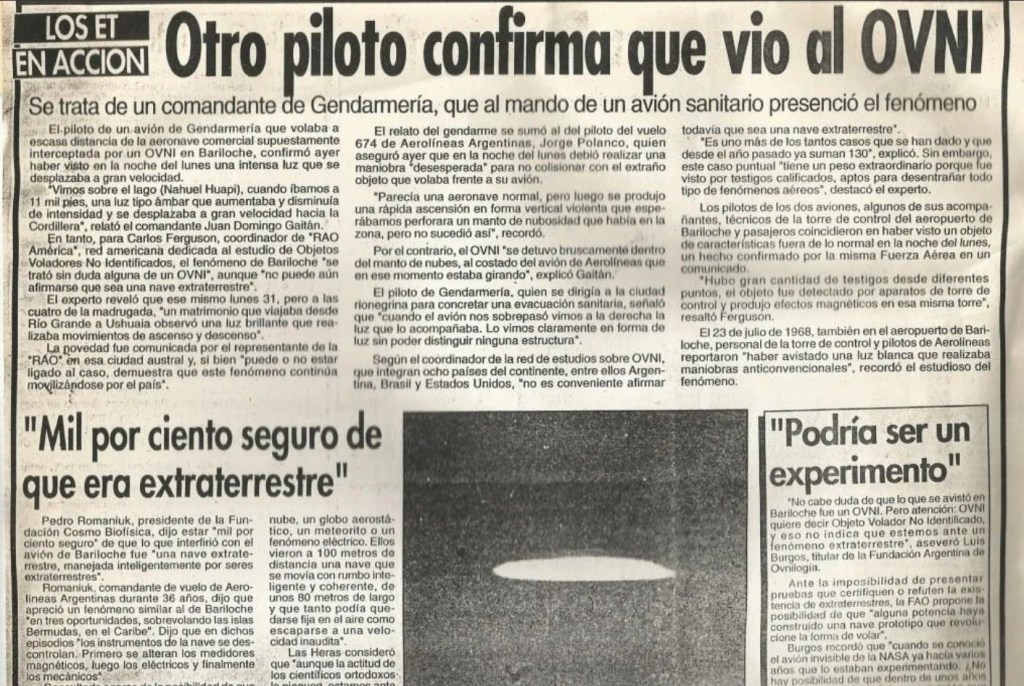
But tonight, they are not alone. Nearby, a National Gendarmerie aircraft (GN-705), a Piper Cheyenne piloted by Commanders Rubén Cipuzak and Juan Domingo Gaitán, is also preparing to land. None of them know they are seconds away from becoming central figures in the most credible and baffling UFO case in South American aviation history.
Act I: The Intruder on Approach
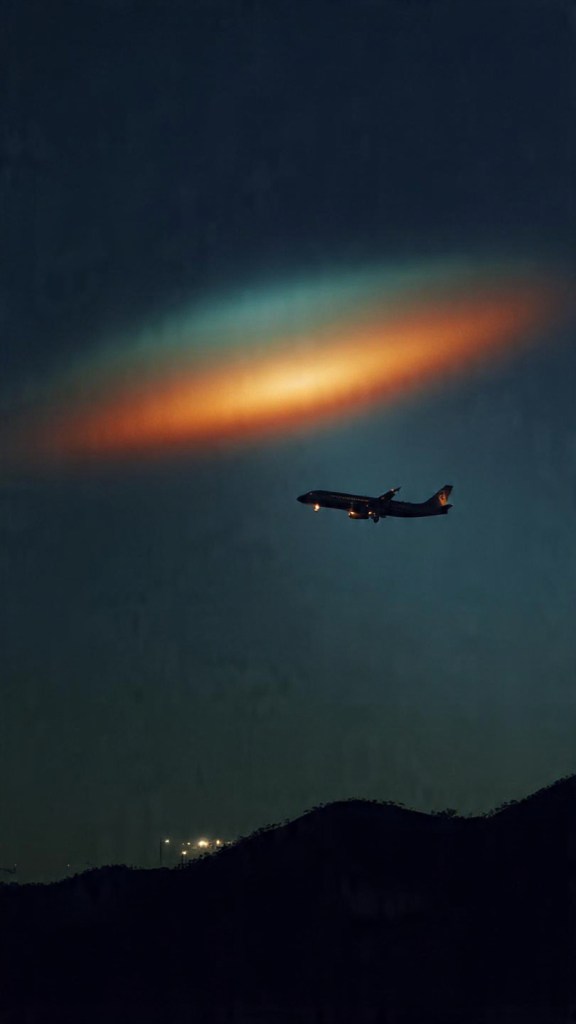
8:17 PM. The silence in the Boeing’s cockpit shatters when the co-pilot alerts Polanco. At the plane’s three o’clock position, a solid, luminous mass cuts through the darkness. It is not a plane. It is not a satellite. It is a lenticular object, which Captain Polanco would later describe as an “inverted soup bowl,” roughly 30 meters (100 feet) in diameter. From its center pulses an orange light that varies in intensity—”as if it were breathing,” he would say—while green lights rotate at dizzying speed around its edges.
The Gendarmerie plane, trailing behind, confirms the impossible over the radio: they’re watching the object position itself practically alongside the Boeing, cutting across their flight path. The control tower confirms visual contact. Then the inexplicable occurs: at the exact moment Polanco aligns with the runway, a total blackout plunges the entire city of Bariloche and the airport into darkness.
The airport’s auxiliary generator kicks in, but the runway lights take precious seconds to return. The Boeing 727 finds itself descending into the void, accompanied by an unknown object that has become the only powerful light source for miles around, bathing the aircraft’s fuselage in amber glow.
Act II: The Escape Maneuver
With no visual references on the ground, instinct and protocol take over.
“Max power! Go-around!” Polanco orders.
The captain initiates the abort procedure. The Boeing’s three engines roar as the 70-ton vessel climbs, searching for altitude while waiting for the lights to return. But the UFO doesn’t fall behind. Defying physics and inertia, the object matches the jet’s acceleration and maintains formation, accompanying them on the ascent to 10,000 feet.
From the Gendarmerie plane, pilots Cipuzak and Gaitán watch the scene in astonishment, narrating what they see over the radio: the object appears to be escorting the commercial airliner. Suddenly, the UFO executes a maneuver impossible for conventional aerodynamics—it banks at a right angle and shoots toward the center of the galaxy at supersonic speed, vanishing into the stratosphere in seconds.
At 8:31 PM, as suddenly as it disappeared, electricity returns to Bariloche and the runway lights flicker back on. The night returns to apparent normalcy, but the reality of those present—including the scientists on board—has changed forever.
Act III: The Wall of Silence and Bureaucratic “Reason”
By morning, the case could not be suppressed. There were too many qualified witnesses: three commercial pilots, two military Gendarmerie pilots, air traffic controllers, ground crew, and passengers including journalist Mariano de Vedia. Polanco recounted the facts with technical precision on national television.
Public pressure forced the Argentine Air Force to investigate. However, years later, when files were declassified (including the 2020 report from the Commission for the Study of Aerospace Phenomena), the official conclusion bordered on insulting. It suggested that pilots with thousands of flight hours had confused the Moon or “spotlights from a nightclub” with a structured craft that had caused an electromagnetic blackout.
It’s the classic playbook of modern cover-ups, the same pattern I analyze in my book: the experience isn’t denied, but the interpretation is ridiculed. Authorities prefer to attribute collective, childish error to elite professionals rather than admit the presence of superior technology violating our airspace with impunity.
Epilogue: A Ghost on the Radar
The “Polanco Case” endures in collective memory because it meets every criterion of hard evidence: multiple visual confirmations (air and ground), radar confirmation (partial but documented), and physical effects (the synchronized blackout).
Its lasting relevance was confirmed 27 years later. On September 9, 2022, crews from Aerolíneas Argentinas and Flybondi again reported anomalous lights pursuing them over the same area of Río Negro. Over the radio frequency, a pilot was heard asking in complete seriousness: “Did we see Polanco’s UFO?“
That phrase says everything. What visited Bariloche in 1995 was not an error, a reflection, or a nightclub spotlight. It was a demonstration of technology that reminds us, as I argue in my research, that we are not the masters of the sky—we are merely its tenants.

 Beyond the Veil: UFO Research
Leave a comment